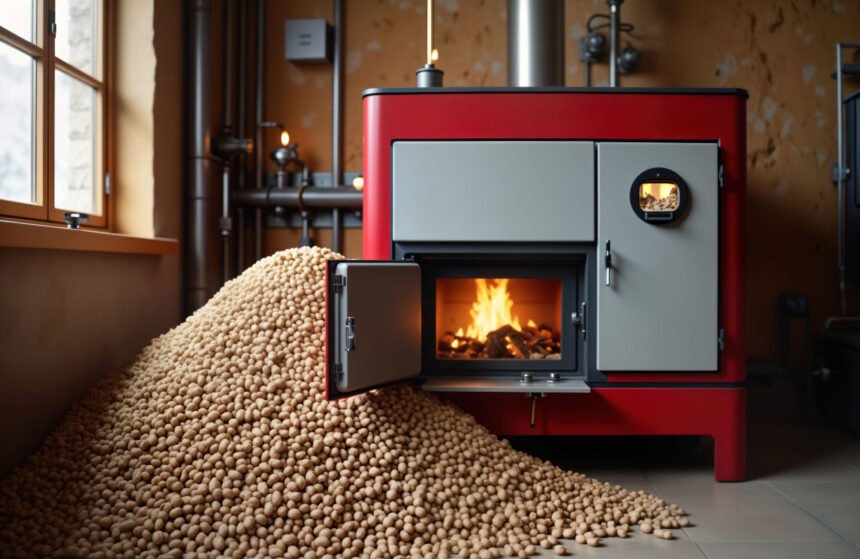
In the global race toward sustainability, homeowners and businesses alike are looking for alternatives to fossil fuels. While heat pumps and solar panels often dominate the headlines, there is an ancient method of heating that has been revolutionized by modern technology: Biomass.
Burning wood for heat is as old as civilization itself, but a modern biomass boiler is miles away from an open campfire or a smoky wood stove. It is a sophisticated piece of engineering that combines the reliability of traditional heating with the eco-credentials of the 21st century.
If you have ever considered switching off the gas grid or ditching your oil tank, you might be asking: How exactly do biomass boilers work? Are they automated? Are they messy? And how do they turn a pile of wood pellets into a steaming hot shower?
In this guide, we will pop the hood on biomass technology to explain the mechanics, the chemistry, and the practicalities of heating with wood.
What is Biomass? (And Why is it Considered Green?)
To understand the machine, you first have to understand the fuel. “Biomass” refers to any biological material used as fuel or an energy source. In the context of heating systems, this almost exclusively means wood.
However, the “green” argument for biomass often confuses people. How can burning wood—which releases carbon dioxide—be good for the planet?
The answer lies in the carbon cycle. When a tree grows, it absorbs carbon dioxide from the atmosphere. When that wood is eventually burned, it releases that same carbon back into the air. Theoretically, this makes the process carbon-neutral; you are simply releasing carbon that was already part of the current atmospheric cycle, rather than unlocking “ancient” carbon trapped deep underground in the form of oil or gas.
Modern biomass boilers utilize three main types of fuel:
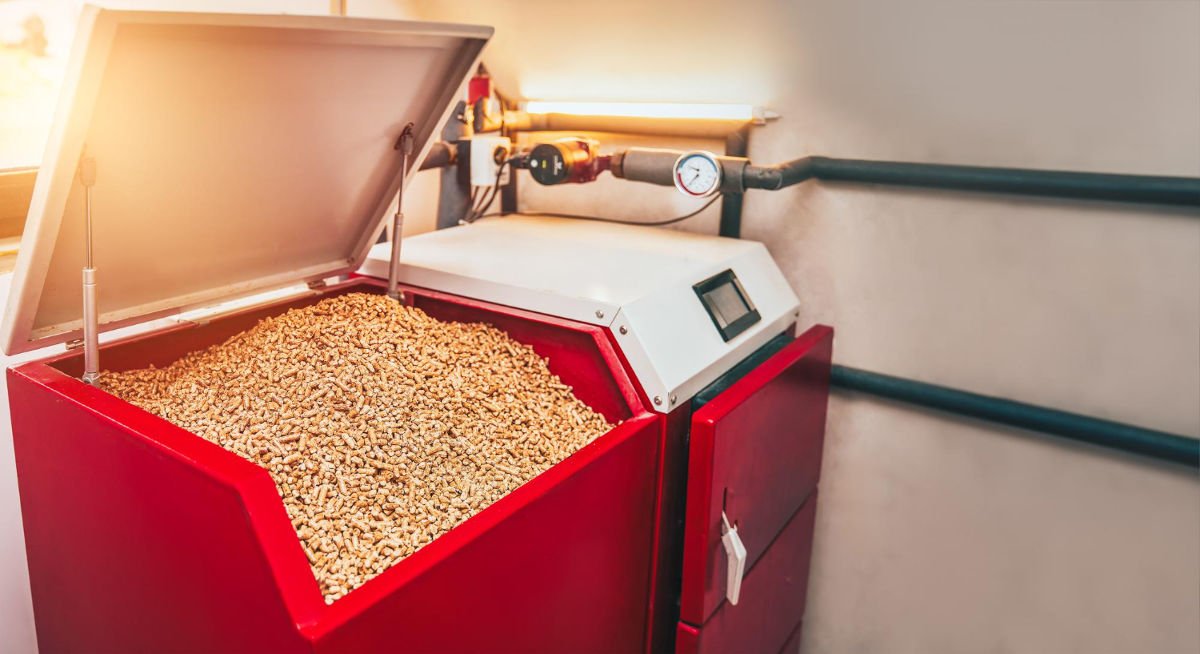
1. Wood Pellets: Compressed sawdust and industrial wood waste. These are incredibly dense, possess a low moisture content, and flow like liquid, allowing for full automation.
2. Wood Chips: Shredded timber. Cheaper than pellets but bulkier, requiring more storage space.
3. Logs: Traditional firewood, usually used in “batch burn” systems where you manually load the boiler.
The Core Mechanism: Step-by-Step
A biomass boiler works on the same fundamental principle as a gas or oil boiler: it burns fuel to heat water, which is then circulated through your central heating system (radiators or underfloor heating). However, the mechanics of handling a solid fuel are far more complex than pumping a liquid or gas.
Here is the step-by-step journey of how a modern automated system (like a pellet boiler) operates.
1. Fuel Storage and Delivery
The process begins in the fuel store. For a biomass boiler to rival the convenience of gas, it needs to feed itself.
Most residential systems feature a large silo or hopper located near the boiler. In a fully automated system, a delivery mechanism transports the fuel from the storage area to the boiler’s combustion chamber.
· The Auger Screw: This is the most common method. Imagine a large Archimedes’ screw inside a tube. As the screw turns, it lifts pellets or chips from the hopper and drops them down a chute into the burner.
· Vacuum Suction: If the storage is too far from the boiler for a rigid screw, a vacuum system can suck pellets through flexible pipes, delivering them to the boiler like a pneumatic tube system at a bank.
2. The Combustion Chamber and Ignition
Once the fuel drops into the burner, the “brain” of the boiler takes over. Unlike a wood stove where you need kindling and matches, a biomass boiler uses an auto-ignition element. This is essentially a super-heated electric rod or hot air blower.
The sequence is precise:
· The auger drops a measured amount of fuel into the burning pot (grate).
· The ignition element heats up.
· A fan blows air across the ignition element, igniting the pellets.
· Optical sensors detect the flame, turning off the igniter to save electricity.
3. Primary and Secondary Combustion (The Gasification Process)
This is where modern engineering shines. If you just burn wood in a metal box, you get a lot of smoke and wasted energy. High-efficiency biomass boilers utilize a process involving two distinct zones of air supply.
· Primary Air: This is introduced at the bottom of the fuel pile. It dries the fuel and starts the burning process, converting the solid wood into volatile gases.
· Secondary Air: This is introduced higher up in the chamber, above the flame. It mixes with the hot gases released by the wood.
By igniting these gases at extremely high temperatures (often exceeding 1,000°C or 1,800°F), the boiler burns off the smoke and particulates that would otherwise go up the chimney. This results in incredibly high thermal efficiency (often over 90%) and very low emissions.
4. The Lambda Sensor
To maintain this perfect burn, premium boilers use a Lambda sensor located in the flue exhaust. This is the same technology found in your car’s engine.
The sensor constantly measures the oxygen levels in the exhaust smoke. If there is too much oxygen, it means the fire is burning too fast or wasting heat; if there is too little, the fire is “choking” and creating smoke. The boiler’s computer adjusts the speed of the fan and the rotation of the fuel auger in real-time to keep the air-to-fuel ratio perfect.
5. The Heat Exchanger
Now that we have generated intense heat, we need to get it into the water.
The hot gases from the combustion chamber are drawn through a heat exchanger. This is usually a series of metal tubes surrounded by a water jacket. As the hot air travels through these tubes, the thermal energy passes through the metal and heats the water surrounding them.
To maximize efficiency, these tubes often contain “turbulators.” These are twisted metal spirals that force the hot air to spin and swirl. This turbulence slows the air down, ensuring it touches the sides of the tubes for longer, squeezing every last drop of heat out before the air exits the flue.
6. The Self-Cleaning Mechanism
One of the biggest fears people have regarding biomass is the cleanup. Wood creates ash; gas does not.
However, modern boilers are designed to be low maintenance. The turbulators mentioned above often move mechanically, scraping the inside of the heat exchanger tubes to stop soot from building up. Meanwhile, the burning grate often has a shaking or tipping mechanism that dumps the ash into a collection bin at the bottom of the unit.
Depending on the size of the bin and the quality of your fuel, you may only need to empty this ash bin once every few months.
The Vital Role of the Buffer Tank
If you look at a diagram of a biomass installation, you will almost always see a large, insulated water cylinder standing next to the boiler. This is the Buffer Tank (or Thermal Store), and the system cannot work efficiently without it.
Gas boilers are “modulating,” meaning they can turn on and off instantly or turn their flame down very low if you only need a little bit of heat. Biomass boilers are different. They are like freight trains; they take a long time to get up to speed and a long time to slow down.
If a biomass boiler turned on every time you washed your hands (demanding hot water for 30 seconds), it would be incredibly inefficient. It would spend all its energy igniting and extinguishing, creating smoke and tar.
Instead, the biomass boiler heats the water in the Buffer Tank. Think of this tank as a giant heat battery.
· The boiler runs hard and hot (its most efficient state) until the tank is fully charged with hot water.
· The boiler turns off.
· When you turn on your shower or your radiators, the hot water is drawn from the tank, not the boiler.
· The boiler sits dormant until the tank’s temperature drops below a certain threshold, at which point it fires up to recharge the “battery.”
This ensures the boiler runs for long, efficient cycles, prolonging the life of the components.
Log Boilers: The Manual Alternative
While the description above focuses on automated pellet systems, log gasification boilers are also popular, particularly for those with access to free firewood.
These work on a “batch burn” principle. You fill a large chamber with logs and light it manually. The boiler burns the entire load rapidly at very high temperatures to gasify the wood. Because you cannot turn a log fire off halfway through, a log boiler must have a very large buffer tank—large enough to store the energy of the entire load of logs. One burn in the evening can often store enough heat to keep a house warm for 24 hours.
Pros and Cons of Biomass Systems
Understanding how they work highlights both the benefits and the drawbacks of these systems.
The Advantages
· Carbon Reduction: Significant reduction in carbon footprint compared to oil, coal, or LPG.
· Cost Stability: Wood prices are generally more stable than the volatile oil and gas markets.
· Efficiency: Modern units operate at 90%+ efficiency, rivaling fossil fuel boilers.
· Waste Utilization: It provides a use for forestry residues and sawmill waste.
The Disadvantages
· Space: You need room for the boiler, the buffer tank, and crucially, the fuel storage. A year’s supply of pellets takes up significantly more space than an oil tank.
· Maintenance: Even with self-cleaning systems, biomass requires more user interaction (emptying ash, ordering fuel deliveries) than a gas boiler.
· Initial Cost: The complex engineering (augers, sensors, heavy steel construction) makes biomass boilers significantly more expensive to install than gas units.
Is Biomass Right for You?
The mechanics of a biomass boiler represent a fascinating blend of elemental fire and digital precision. By strictly controlling the airflow, automating the fuel delivery, and utilizing thermal storage, these machines maximize the energy potential of wood while minimizing pollution.
Ideally, biomass boilers are suited for:
· Properties off the main gas grid.
· Older, larger homes with high heat demands (where heat pumps might struggle to reach high temperatures).
· Homeowners with space for fuel storage.
· People who want a green solution but prefer the high-temperature heat characteristics of a traditional boiler system.
While they require a bit more involvement than the “fit and forget” nature of a gas combi-boiler, the satisfaction of heating your home with a renewable, potentially local resource is a warmth that goes beyond just temperature. As technology advances, biomass continues to prove that wood—one of humanity’s oldest fuels—still has a bright, burning future.
Początek formularza
Dół formularza