

If you’ve ever tried streaming a show abroad or logging into work from a café, you may have noticed your connection isn’t always private. Many users ask the same question: Is a proxy the same as a VPN? The short answer is no, but understanding why helps you choose the right tool for privacy and speed.
In this guide, you’ll learn:
- The quick answer to whether a proxy is the same as a VPN
- How proxy servers and VPNs work
- Key differences in encryption, privacy, and speed
- When to use each tool and when to combine them
Let’s start with the core question before diving into how each works.
1. Is a proxy the same as a VPN?
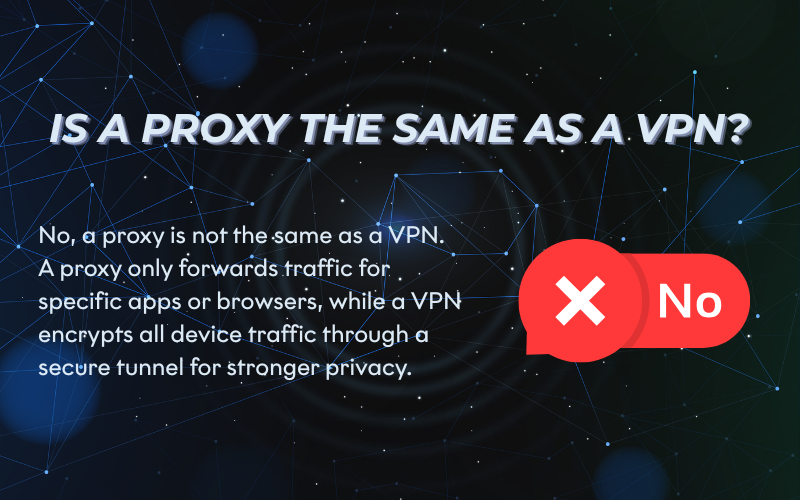
No, a proxy is not the same as a VPN. Both can hide your IP address, but they operate differently. A proxy works at the application level, forwarding traffic for specific apps or browsers. A VPN, on the other hand, encrypts all internet traffic across your device, creating a secure “tunnel” between you and the web.
 To make this clearer, here’s a side-by-side comparison that directly answers the question Is a proxy the same as a VPN:
| Feature | Proxy server | VPN |
| Encryption | Usually none | Strong encryption (AES, IPSec, etc.) |
| Scope | App or browser level | Device-wide (all traffic) |
| Speed | Often faster but less secure | Slightly slower due to encryption |
| Cost | Many free options, limited features | Paid services with stronger protection |
Both have their use cases, but for privacy and security, a VPN offers broader and stronger protection.
2. What is a proxy server
Before comparing further, let’s break down how proxies work and their different types.
2.1. How a proxy works
A proxy server acts as a middleman between your device and the internet. When you request a website, the proxy forwards the request on your behalf and sends the response back. This hides your real IP address from the site you visit.
In real-world use, I’ve seen students rely on web proxies to quickly access blocked sites on campus. However, because there’s no encryption, their data is still visible to the network administrator. According to the Electronic Frontier Foundation (EFF, 2023), proxies offer minimal privacy and should not be mistaken for full security tools.
2.2. Types of proxy servers
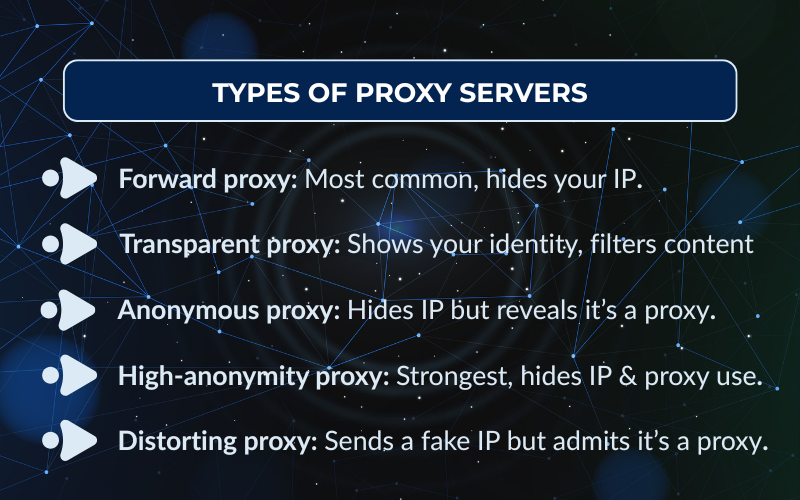
There are several types of proxies, each serving a different purpose:
- Forward proxy: The most common, used by individuals to hide their IP.
- Transparent proxy: Reveals your identity but filters content, often used by schools or offices.
- Anonymous proxy: Hides your IP but may still identify itself as a proxy.
- High-anonymity proxy (elite): Provides stronger masking by not revealing proxy use.
- Distorting proxy: Sends a false IP address while identifying itself as a proxy.
Each type balances anonymity, compatibility, and performance differently.
2.3. What is a reverse proxy
Unlike forward proxies, a reverse proxy sits in front of web servers rather than clients. It helps businesses manage traffic, improve performance, and enhance security.
For example, companies like Cloudflare use reverse proxies to absorb DDoS attacks before they hit the actual servers.
3. What is a VPN
A Virtual Private Network (VPN) is a service that creates an encrypted tunnel between your device and the internet. Unlike a proxy, which only forwards traffic for specific apps, a VPN secures all network connections on your device. This makes it a stronger solution when privacy, security, and data protection are priorities.
3.1. How a VPN works
When you connect to a VPN, your internet traffic is routed through a secure server operated by the VPN provider. This process:
- Encrypts your data so outsiders cannot read it
- Masks your real IP address, replacing it with the server’s IP
- Allows access to region-restricted content by letting you appear in another country
If you’re new and want step-by-step instructions, here’s a guide on how to set up a VPN for different devices.
3.2. Client VPN vs site-to-site VPN
There are two main types of VPN setups:
- Client-based VPN: Installed as an app on your computer or phone. It protects personal internet traffic, commonly used by individuals.
- Site-to-site VPN: Used by businesses to securely link entire networks, such as a branch office to headquarters. This allows employees to share resources as if they were on the same local network.
For home or mobile users, client VPNs are the most relevant. Businesses, however, benefit from site-to-site VPNs for efficiency and secure remote access. To explore additional VPN safety tips, visit Safelyo.
3.3. Popular VPN protocols (OpenVPN, WireGuard, IPsec/IKEv2)
VPNs rely on protocols to define how the encrypted tunnel works. The most widely used include:
- OpenVPN: Highly secure, open-source, and widely adopted.
- WireGuard: Known for speed and modern cryptography, increasingly popular since 2020.
- IPsec/IKEv2: Strong for mobile devices due to its stability when switching between Wi-Fi and cellular data.
Each protocol balances security, speed, and compatibility differently. Safelyo’s analysis shows that WireGuard often achieves the best speeds, while OpenVPN remains a standard for reliability across platforms.
4. Proxy vs VPN differences
At this point, it’s clear that a proxy and a VPN are not the same. Still, many users wonder is a proxy the same as a VPN when it comes to privacy or speed. To answer that, let’s compare them across key factors that impact both individuals and businesses.
4.1. Encryption and privacy
A VPN encrypts all traffic leaving your device. This makes it unreadable to ISPs, hackers, or public Wi-Fi snoopers.
Proxies, however, usually do not encrypt traffic. That means sensitive data such as passwords or payment details can still be intercepted.
4.2. App-level vs device-wide coverage
A proxy only handles traffic from specific applications, such as a web browser. If you open another app, that traffic bypasses the proxy entirely.
A VPN, by contrast, works system-wide. It protects every application and background process on your device. This makes VPNs far more effective for comprehensive privacy.
4.3. Speed and performance
Because proxies don’t encrypt data, they may feel faster in some cases. However, free proxy servers are often overcrowded, which leads to unstable connections.
VPNs can be slightly slower due to encryption overhead. But premium VPN providers use optimized servers to minimize speed loss.
In my own testing, WireGuard-based VPN connections were only about 5–10% slower than a direct connection. For streaming and gaming, this drop is barely noticeable.
If you want strong security without overspending, you can choose from the best cheap VPNs that balance price and performance
4.4. Identity and login risks
A proxy hides your IP but does not mask login details. If you log into Google or Facebook through a proxy, those platforms still know it’s you.
VPNs encrypt the entire session, adding an extra layer of anonymity. While they cannot fully anonymize your identity if you log in with personal accounts, they reduce the risk of third-party tracking.
4.5. Business use cases
Proxies are often used by businesses to manage web traffic, apply filters, or cache frequently accessed content.
VPNs, on the other hand, are critical for remote work. They allow employees to securely access company resources from anywhere.
A small business might deploy a reverse proxy for load balancing but rely on a site-to-site VPN for secure collaboration.
5. When to use a proxy
A proxy can be useful in specific scenarios where full encryption is not necessary. It’s a lightweight tool for masking your IP address and handling simple browsing tasks.
Here are common cases where a proxy makes sense:
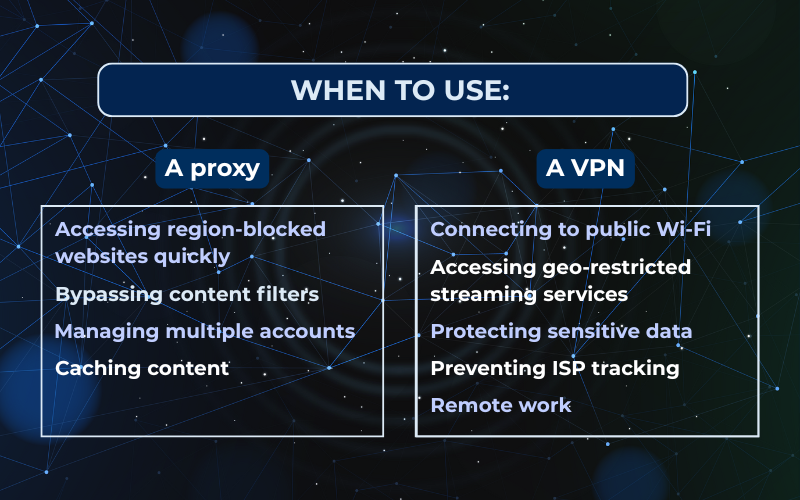
- Accessing region-blocked websites quickly without needing device-wide encryption.
- Bypassing content filters on networks such as schools or offices.
- Managing multiple accounts (for example, social media managers who need different IPs).
- Caching content to improve loading speed for repeated requests, often used in businesses.
That said, proxies should not be your go-to option for sensitive activities. If you’re shopping online, entering passwords, or sending work documents, you need stronger protection than a proxy can provide.
6. When to use a VPN
A VPN is the right choice whenever security and privacy are your top priorities. Unlike proxies, it protects all apps and encrypts every bit of data leaving your device.
If you often connect in airports, hotels, or cafés, choosing the best VPN for public Wi-Fi ensures your traffic stays private.
Here are situations where a VPN is strongly recommended:
- Connecting to public Wi-Fi at airports, hotels, or cafés where attackers may snoop on traffic.
- Accessing geo-restricted streaming services like Netflix, Hulu, or BBC iPlayer.
- Protecting sensitive data such as online banking or confidential work files.
- Preventing ISP tracking by hiding your browsing activity from your internet provider.
- Remote work where employees need secure access to company servers.
7. Can you combine proxy and VPN?
Yes, you can combine a proxy with a VPN, but it depends on your goals. When used together, the VPN handles encryption and device-wide protection, while the proxy adds another layer for traffic routing.
This setup can be helpful in cases such as:
- Extra IP masking if you want your traffic routed through both a VPN and a proxy.
- Specialized business use where proxies manage content filters, and VPNs secure remote connections.
- Bypassing restrictions that block either proxies or VPNs individually.
For everyday users, running both is often unnecessary. A VPN alone already provides strong encryption and privacy. Proxies are better kept for lightweight tasks that don’t require full protection.
8. FAQs about is a proxy the same as a VPN
Before we wrap up, here are some quick answers to common questions people ask about proxies and VPNs.
8.1. Is a proxy safer than a VPN?
No. A proxy only hides your IP address but does not encrypt traffic. A VPN provides encryption, which makes it much safer for sensitive activities like online banking or remote work.
8.2. Can I use a free proxy instead of a VPN?
Yes, but with caution. Free proxies often lack encryption, log user activity, or run on overloaded servers. For privacy, a VPN is a more reliable option.
8.3. Will a VPN slow down my internet more than a proxy?
Sometimes. VPNs can introduce a small speed drop due to encryption. However, modern VPN protocols such as WireGuard are optimized for high performance, and premium VPNs often maintain near-normal speeds.
8.4. Do proxies and VPNs hide browsing from my ISP?
Proxies do not hide your browsing from your ISP, they only mask the IP you connect to. VPNs encrypt traffic, so your ISP can see you are using a VPN but not the sites you visit.
8.5. Can I use both at the same time?
Yes, but it’s usually unnecessary for most people. Combining them may help in niche cases like bypassing strict firewalls, but for daily privacy and streaming, a VPN alone is enough.
9. Conclusion
So, is a proxy the same as a VPN? No. While both can hide your IP address, only a VPN encrypts your traffic and provides full device-wide protection. Proxies are lightweight and useful for simple tasks, but they fall short on privacy and security.
Here’s a quick recap:
- Proxies work at the app level and usually lack encryption.
- VPNs secure your entire device with strong encryption.
- Proxies are better for lightweight browsing or bypassing filters.
- VPNs are essential for privacy, streaming, online banking, and remote work.
For more simple and practical tech tutorials, explore the Privacy & Security Basics section at Safelyo.
Contact information:
- Website: https://safelyo.com/
- Office address: 4/567 Group 10 Hoa Lan 1 Residential Area, Thuan An, Binh Duong, Viet Nam
- Email: info@safelyo.com
- Fanpage: https://www.facebook.com/safelyoglobal
- YouTube: https://www.youtube.com/@Safelyo
- Office hours: Monday – Friday: 9:00 AM – 5:00 PM (GMT+7)