Reliable elemental analysis is the backbone of modern laboratory operations, from monitoring heavy metals in drinking water to verifying alloy compositions in metallurgy. Achieving this level of precision requires Inductively Coupled Plasma Emission Spectroscopy, a powerful analytical technique used for high-speed, simultaneous multi-element analysis. Often referred to as inductively coupled plasma optical emission spectroscopy, this method relies on a high-temperature plasma source to excite atoms, which then emit light at characteristic wavelengths. Selecting the right ICP OES spectrometer ensures your lab can handle diverse matrices with high sensitivity and minimal interference.
At a Glance: Selection Checklist
- Wavelength Coverage: Does it cover the full spectrum required for your elements?
- Sensitivity: Are the ppb detection limits sufficient for your regulated methods?
- Viewing Mode: Do you need axial, radial, or dual view ICP-OES?
- Throughput: Is there an automated ICP-OES system with a robust autosampler?
- Compliance: Does the software support 21 CFR Part 11 or LIMS integration?
Define Your ICP-OES Use Cases: Samples, Elements, and Reporting Requirements
Before evaluating hardware, clearly define the trace metals analysis needs of your facility. Different industries face unique challenges: environmental testing often requires high sensitivity for toxic elements, while petrochemical matrices or metallurgy samples may involve high total dissolved solids (TDS).
Consider your typical sample preparation workflow, such as acid digestion or simple dilution. Your reporting requirements—whether they are in parts-per-billion (ppb) or parts-per-million (ppm)—will dictate the performance tier of the inductively coupled plasma spectrophotometer you need to procure.
Detection Limits, Accuracy, and Linear Range: Matching Performance to Your Needs
The primary goal of an ICP OES spectrometer is to provide accurate data across a wide concentration range.
- Detection Limits: Ensure the instrument can comfortably meet your lowest required concentrations without struggling against the “noise.”
- Linear Dynamic Range: A wide range allows you to measure trace and major elements in a single run, reducing the need for time-consuming re-runs or multiple dilutions.
- Method Robustness: Look for features that manage spectral interference and matrix effects. Modern systems use advanced background correction and internal standards to maintain accuracy even when dealing with complex or varying sample types.
Throughput and Automation: Autosamplers, Workflows, and High-Volume Operation
For high-volume QA/QC environments, speed is just as important as accuracy. An automated ICP-OES system should streamline the transition from sample to result with minimal manual intervention.
Key automation components to check include:
- Autosampler Compatibility: Look for high-capacity racks and fast rinse cycles to prevent carryover.
- Peristaltic Pump Reliability: Constant, pulse-free flow is essential for stability.
- Drift Monitoring: The software should automatically run QC samples and perform drift monitoring to ensure the system stays within calibration throughout long sequences.
Optical Design and Viewing Configuration: Full Spectrum, Direct Reading, and Dual View
The optical core determines how the light is captured and analyzed. Most high-end units utilize an echelle spectrometer paired with a CCD / CID detector to enable a full spectrum ICP-OES analysis.
The viewing configuration is particularly critical:
- Axial Observation: Provides the highest sensitivity for low-level trace metals analysis.
- Radial Observation: Better for high-concentration samples and minimizing interference from complex matrices.
- Dual View ICP-OES: This is often the best choice for versatile labs, as it allows the system to automatically switch between axial and radial views within a single method, optimizing the measurement for each specific element.
Software, Data Integrity, Safety Controls, and Service Considerations
The hardware is only half of the equation; the software must be intuitive yet powerful. For regulated industries like food safety or pharmaceuticals, the software must include an audit trail and meet 21 CFR Part 11 requirements to ensure data integrity.
Finally, consider the total cost of ownership:
- Gas Consumption: High-efficiency plasma torch designs can significantly reduce argon consumption and daily operating costs.
- Safety: Ensure the unit features a reliable solid-state RF generator with interlocks for gas pressure and cooling.
- Service: Confirm that the nebulizer and spray chamber are easy to clean and that local technical support is readily available for routine maintenance.
Why Torontech Is the Best Choice for Inductively Coupled Plasma Emission Spectroscopy Solutions
Accuracy, speed, and reliability are non-negotiable in the modern lab. Torontech provides industry-leading Inductively Coupled Plasma Emission Spectroscopy solutions designed to simplify even the most complex analytical challenges.
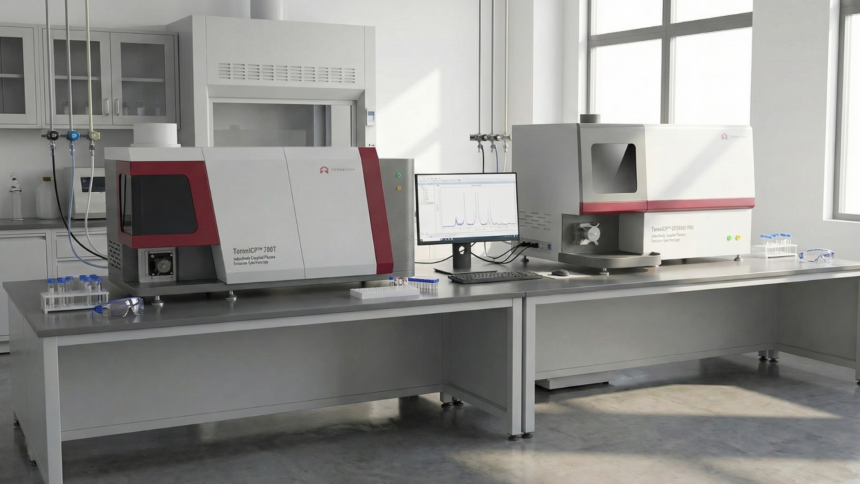
Our ICP OES spectrometer range combines advanced optical design with user-centric software, ensuring your team can achieve consistent results from day one. Whether you are performing routine environmental monitoring or specialized material research, Torontech offers the inductively coupled plasma emission spectroscopy (ICP-OES) system you need to protect your quality standards and optimize your laboratory’s productivity.