What Should You Know About Domestic Biomass Boilers? A Complete Homeowner’s Guide

As the world pivots toward sustainable energy and homeowners look for ways to insulate themselves from volatile fossil fuel markets, the search for alternative heating solutions has never been more intense. While heat pumps often grab the headlines, there is another powerful, low-carbon contender that offers high-temperature heating and a cozy, traditional feel: the domestic biomass boiler.
If you are considering ripping out that old oil tank or gas boiler, you likely have questions. How do they work? Are they expensive to run? How much maintenance do they really need?
In this comprehensive guide, we will explore everything you need to know about domestic biomass boilers, from the different types available to the installation process, costs, and the realities of living with one.
What Exactly is a Biomass Boiler?
In simple terms, a biomass boiler is a heating system that burns organic material—usually wood—to generate heat for your home’s central heating and hot water. It works on the same principle as a standard fossil fuel boiler, but instead of burning gas or oil, it burns biological matter.
The primary appeal is environmental. Biomass is considered a carbon-neutral energy source. The carbon dioxide released when the wood is burned is roughly the same amount the tree absorbed while it was growing. As long as new trees are planted to replace those harvested (which is standard practice in sustainable forestry), the net impact on atmospheric carbon is minimal compared to burning fossil fuels that have been locked underground for millions of years.
Types of Biomass Boilers for the Home
Not all biomass boilers are created equal. Choosing the right type depends entirely on your available space, your access to fuel, and how much manual labour you are willing to do.
- Wood Pellet Boilers
Pellet boilers are the most common choice for modern domestic installations.
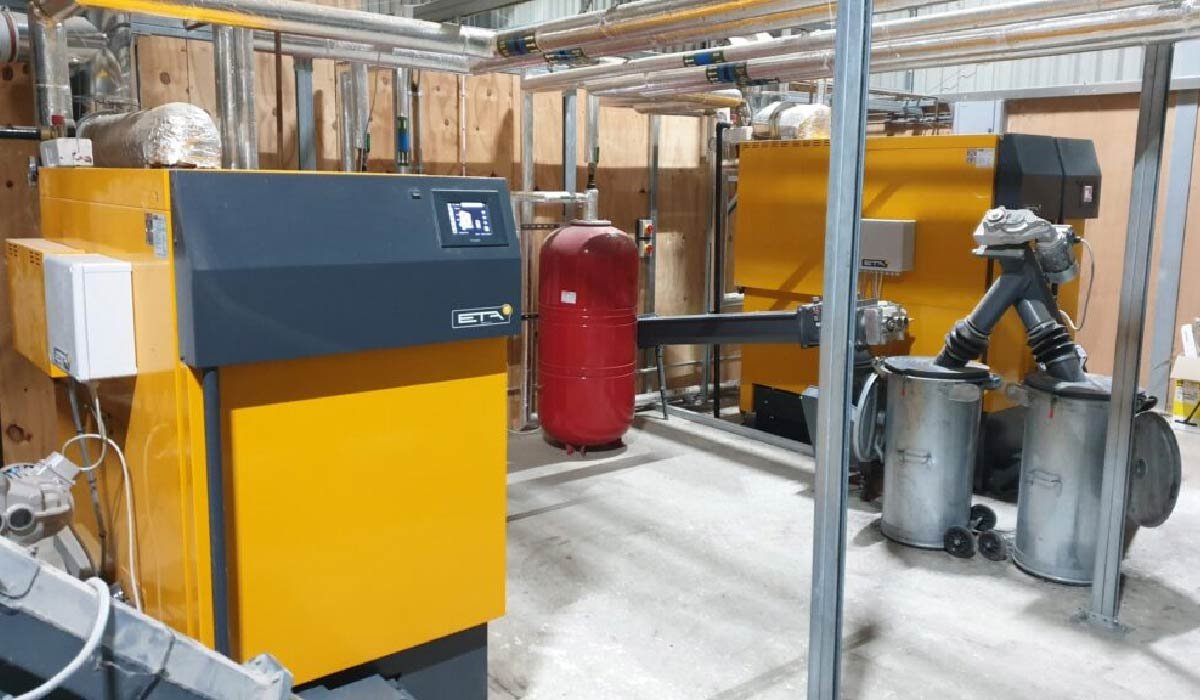
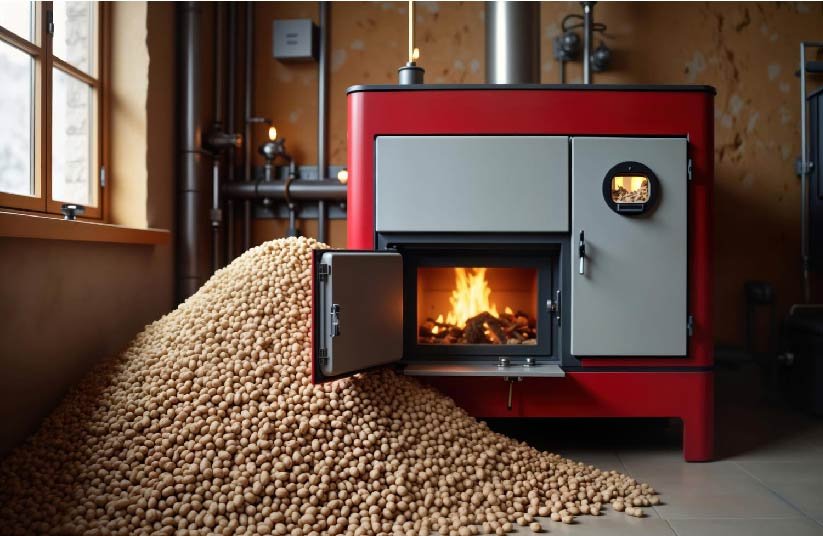
- How they work:These boilers burn compressed sawdust pellets. They are highly automated; the pellets are usually stored in a hopper or silo and automatically fed into the boiler via an auger (screw) or vacuum system as heat is required.
- The Experience:They offer an experience closest to a gas boiler. You can control them with a thermostat and timer.
- Best for:Homeowners who want a “hands-off” renewable heating system and have a small amount of space for pellet storage.
- Log Boilers (Batch Boilers)
- How they work:These require you to manually load logs into the combustion chamber. They are usually fired up once a day to heat a large volume of water stored in a “buffer tank” (accumulator), which then feeds your radiators throughout the day.
- The Experience:This is a lifestyle choice. You need a reliable supply of dry logs and the physical ability to load the boiler daily.
- Best for:People with access to their own wood supply (e.g., farms or large estates) who don’t mind the physical labour.
- Wood Chip Boilers
- How they work:These burn wood that has been chipped into small, uniform pieces.
- The Experience:They are fully automated like pellet boilers but the fuel is less energy-dense, meaning you need a much larger storage area. The mechanics are more robust and industrial.
- Best for:Large properties, farms, or several houses sharing a single “district” heating system. They are rarely installed in standard single-family homes due to the space required for the chips.
- Biomass Stove with Back Boiler
- How they work:This looks like a traditional wood-burning stove in your living room, but it has a boiler integrated into the back. It heats the room via radiation and heats water for your radiators.
- Best for:Smaller, well-insulated homes or as a supplementary heating source.
The Installation Process of a Biomass Boiler
Installing a biomass boiler is significantly more complex than swapping out a gas combi-boiler. It requires planning, space, and plumbing modifications. Here is what the process generally looks like:
Phase 1: The Site Survey and Heat Loss Calculation
Before you buy anything, an engineer must calculate your home’s heat loss. Biomass boilers work best when sized correctly. If the boiler is too big, it will cycle on and off too frequently (known as “slumbering”), which reduces efficiency and increases tar buildup.
Phase 2: Fuel Storage Integration
This is the biggest hurdle for most homes.
- Internal Hoppers:Some pellet boilers have a small hopper built-in that you fill manually from bags every few days.
- External Silos:For full automation, you will install a bulk silo (often made of fabric or steel) in a garage, shed, or purpose-built outhouse. A vacuum tube or auger will connect this storage to the boiler. The delivery truck needs to be able to get within roughly 20 meters of this store to blow the pellets in.
Phase 3: The Flue System
Biomass boilers require a specific type of flue (chimney) to handle the exhaust gases. If you have an existing chimney, it may need to be lined with stainless steel. If not, a twin-wall insulated stainless steel flue system will need to be installed, usually running up the side of your house.
Phase 4: Buffer Tank Installation
Unlike gas boilers that can turn on and off instantly, biomass boilers take time to heat up and cool down. Therefore, they are almost always installed with a buffer tank (thermal store).
The boiler runs hard and fast to heat the water in this large tank (often 500 to 1,000 liters). Your radiators and hot water taps then draw heat from the tank, not directly from the boiler. This improves efficiency and longevity.
Phase 5: Commissioning
Once plumbed and wired, the engineer will program the boiler, calibrate the fuel feed, and ensure the combustion levels are safe and efficient.
Costs of Installing a Biomass Boiler at Home
Let’s address the elephant in the room: Biomass boilers are capital-intensive.
The Upfront Cost
In the current market, a fully automated domestic wood pellet boiler system usually costs between £11,000 and £20,000 ($14,000–$25,000), including installation, the flue, and the fuel store.
- Log boilerscan be slightly cheaper (£7,000–£13,000) but require the buffer tank which adds cost.
- Manual feed pellet boilers(without the bulk silo) are on the lower end of the price spectrum.
The Running Costs
The cost of fuel varies. Wood pellets are generally cheaper per kWh than electricity and often cheaper than oil, though they fluctuate with the market.
- If you buy pellets in bulk (blown from a tanker), you get a better rate than buying 15kg bags on a pallet.
- If you have a log boiler and your own woodland, your fuel cost is effectively zero (excluding your labour and chainsaw petrol).
Government Incentives
Because biomass is a green technology, many governments offer financial aid.
- In the UK, for example, the Boiler Upgrade Scheme (BUS)currently offers significant grants (up to £5,000 or more depending on current legislation) to help cover the upfront cost of biomass boilers in properties that cannot be heated by heat pumps.
- In the US, federal tax credits for efficient biomass heaters can cover a percentage of the installation and equipment costs.
- Always check your local government regulations, as these incentives change frequently.
Comprehensive Guide to Services and Maintenance
This is the area where homeowners are often caught off guard. A gas boiler can be ignored for 364 days a year. A biomass boiler requires a relationship.
User Maintenance (What you do)
Depending on the sophistication of your boiler, you will need to perform weekly or monthly tasks:
- Emptying the Ash Pan:Even highly efficient boilers produce ash. In a high-end automated boiler, the ash is compressed into a box you might only empty 4-6 times a year. In cheaper models, this might be a weekly task.
- Cleaning the Heat Exchanger:Most modern boilers have a lever you pull to scrape the heat exchangers clean of soot. This ensures maximum heat transfer.
- Checking Fuel Levels:Ensuring your hopper doesn’t run dry.
- Glass Cleaning:If your unit has a viewing window, you’ll need to wipe off soot to keep the flame visible.
Professional Servicing (What the pro does)
An annual service by a qualified engineer is mandatory, especially if you want to keep your warranty valid and claim any government incentives.
The Annual Service Checklist:
- Deep Clean:The engineer will strip the boiler down, vacuuming out all internal ash pathways, the fan, and the combustion chamber.
- Safety Checks:Testing safety sensors (overheat protection) and fire safety valves.
- Ignition Inspection:The ignition element (which lights the pellets) is a consumable part and may need replacing every few years.
- Software Update:Checking the boiler’s computer for firmware updates to improve efficiency.
- Flue Sweeping:The chimney must be swept to remove soot and creosote buildup, which is a fire hazard.
Common Maintenance Issues
- Auger Jams:Occasionally, dust or oversized pellets can jam the screw mechanism.
- Ignition Failure:If the heating element wears out, the boiler won’t light.
- Sensor Errors:Dust can obscure sensors, leading the boiler to think it has no fuel.
Pros and Cons: A Quick Summary
Before you make your decision, weigh these factors:
The Pros:
- High Temperatures:Unlike heat pumps which run at lower temperatures, biomass boilers produce high heat (70°C+), meaning you usually don’t need to replace your existing radiators.
- Carbon Neutral:excellent for reducing your carbon footprint.
- Fuel Independence:You are not reliant on the gas grid.
- Reuse of Waste:Uses waste wood products (sawdust/chips) effectively.
The Cons:
- Space:You need significant space for the boiler unit, the buffer tank, and the fuel storage.
- Maintenance:It requires more interaction and cleaning than gas or electric heating.
- Upfront Cost:It is expensive to install without grants.
- Air Quality:While better than open fires, they do emit particulate matter (PM2.5). You must ensure you are in a zone that permits wood burning and use an Eco-Design ready compliant boiler.
Is a Biomass Boiler Right For You?
Domestic biomass boilers are not for everyone. If you live in a small urban apartment or a house with no garden access for deliveries, this is not the solution for you.
However, a biomass boiler is an exceptional choice if:
- You live off-grid:If your current options are expensive LPG or heating oil.
- You have an older, draftier home:Biomass provides the high-temperature punch needed to heat older stone or brick properties that heat pumps might struggle with.
- You have space:You have a garage, outbuilding, or large utility room.
- You want to go green:You are committed to moving away from fossil fuels.
Conclusion
Switching to a domestic biomass boiler is a significant commitment, both financially and in terms of lifestyle. It marks a transition from being a passive consumer of energy (flipping a switch) to an active participant in your home’s heating (managing fuel and maintenance).
However, for the right property, the rewards are substantial. You gain a warm, powerful heating system that utilizes sustainable fuel, cuts your carbon emissions drastically, and can—depending on oil and gas prices—lower your monthly bills.
If you think biomass is the right path for you, the next step is to contact a MCS (Microgeneration Certification Scheme) certified installer or the equivalent certified body in your country. They can provide a specific heat loss calculation for your home and a quote tailored to your needs. The future of heating is green, and for many, that future is wood-fueled.