When it comes to exploring the Everest region, it is far more than just observing the mountains. While that stays as the primary motive, in recent years, trekkers are equally fond of the landscapes and the cultural and traditional practices. Moreover, what sets this region apart from others is the different ways you can experience it. You can either opt for the iconic way and go for a trek or opt for a guided helicopter tour. They are a more time-saving and luxurious way to explore the region. Similarly, for seasoned trekkers who are looking for more challenging adventures, peak climbing offers an opportunity to get into mountaineering.
Trek: The Classic Way
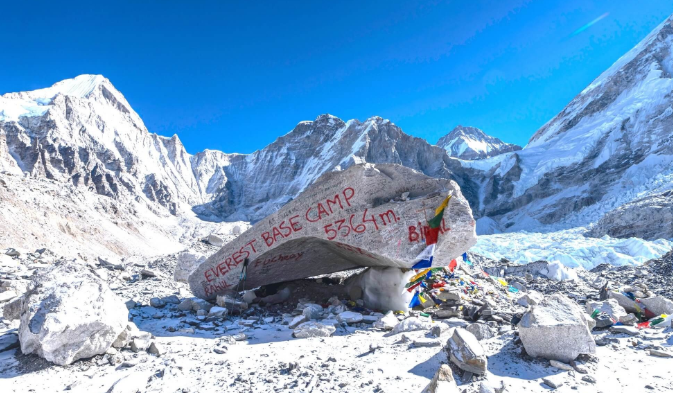
The Everest Base Camp Trek takes trekkers to the Solukhumbu district in Nepal’s Khumbu region. It offers one of the most iconic high altitude journeys in the world. Similarly, this journey reaches the foot of Mount Everest (8,848.86 m) and offers dramatic alpine scenery. Trekkers pass through traditional Sherpa villages and suspension bridges with fluttering prayer flags reflecting the Tibetan Buddhist practices.
The trails comprise rhododendron forests, rolling hills, terraced fields, mountains and glacial landscapes. The journey typically begins with a Lukla flight and follows the Dudh Koshi River valley. After that, it ascends to Namche Bazaar, which is a bustling gateway to the Khumbu that used to be a trading hub. Trekkers take an acclimatization day here to help them to prepare for higher altitudes and reduce the risk of Acute Mountain Sickness (AMS).
Trek’s primary highlight is the sunrise from Kala Patthar, where golden light illuminates Everest and neighboring peaks. Other mountains that trekkers can witness during the journey are Lhotse, Nuptse, Ama Dablam, Thamserku, Pumori and Lobuche East. Similarly, trekkers can visit ancient monasteries like Tengboche and gain insight into Buddhist traditions that are deeply rooted in the region.
Despite the rewards, trekking to the EBC takes about 2 weeks. Similarly, its trekking routes consist of significant ascents and descents, stone stairs, glacier walks, and sharp ridges. This can be challenging to complete for everyone. For those, the Everest Base Camp Trek with Helicopter Return is an ideal option. You trek through the same trails, explore the same villages, and skip the tiring on-foot descent at the end.
Guided Helicopter Tour
It is the fastest and most comfortable way to explore the region. Unlike the classic trek, it does not take 2 weeks; instead, it is completed in just a day. So, it is an ideal option if you have a busy schedule or any health issues that prevent you from trekking. During the Everest Base Camp Heli Tour, trekkers can choose to land at specific landmarks like Kala Patthar. They get about 30 minutes here to soak in the panoramic views and take pictures and videos. Alternatively, they can go for just the flyover tour, where they hover close to the viewpoints without making any landing.
Scenic Rewards
- Witness breathtaking aerial views of Mount Everest, Lhotse, Nuptse, Ama Dablam, Pumori, Thamserku, and Kangtega.
- Fly over the Khumbu Glacier, which is one of the longest and highest glaciers in Nepal. Moreover, trekkers can also observe its crevasses, icefalls, and shifting textures.
- The traditional Sherpa villages and the trekking routes appear like small dots and lines.
- Get an aerial view of the beautiful Everest Base Camp and the majestic Kala Patthar.
- Below, you can see the lush green hills, forests, rivers, and several mountain valleys.
- Lastly, the changing landscapes appear visually appealing.
- This tour presents a unique chance to capture the bird’s-eye view of the entire Everest region and its Himalayan giants.
Peak Climbing
It is a popular and more thrilling adventure that the Everest region has to offer. Since it sits between Himalayan trekking and full-scale mountaineering it is perfect for introductory climbs. “Peak climbing” generally refers to mountains that are less than 6,500 meters high. Once you complete these, you can make a shift towards more technical ones (7,000 meters to 8,000 meters).
Previous experience is generally not required, as the routes are defined. Moreover, you will have guidance from a professional climbing leader. It is still physically more demanding than trekking and demands strong stamina, endurance, and mental focus. Even though advanced skills are not necessary, you should know how to operate crampons, an ice axe, an ice screw, and ropes. Similarly, proper acclimatization is a key part of the process to reduce the threat of Acute Mountain Sickness. That being said, Mera Peak Climbing is one of the most beginner-friendly options so let’s dive deeper into it.
Mera Peak
It is widely regarded as one of the best introductory mountains of Nepal. This peak has an elevation of 6,476 meters and falls amongst the less technical ones. Similarly, it has more of a gradual elevation gain setting, making it ideal for the first-timers. The climb to Mera Peak starts with a quiet and scenic Hinku Valley. Similarly, the summit and descent back take 15 days in total via slow and steady slopes with long and sustained ascents. Despite having minimal technical challenges, accumulated physical fatigue makes the climb challenging. They also have to tackle exposed rocky sections. So, trekkers should maintain a slow pace, take frequent breaks and wear proper gear. From the summit, climbers get a stunning visual reward.
- Mount Everest – the world’s highest peak visible on the distant horizon
- Lhotse – massive neighboring wall-like summit
- Makalu – sharp and pyramid-shaped peak in the distance
- Cho Oyu – broad, snow-covered giant on the Tibetan side
- Kanchenjunga—a faint but visible far eastern horizon on clear days
- Nuptse – dramatic ridge formations near Everest
- Chamlang – striking massif dominating nearby views
- Endless Himalayan ranges, glaciers, and deep valleys stretching across Nepal and Tibet
- Hinku Glacier and the Hinku Valley
Required Gear
- Thermal inner layer
- Fleece of Soft Shell jacket
- Down suit or a summit suit
- Buff or gaiter
- Insulated gloves
- Warm hat or beanie
- Mountaineering boots
- Crampons
- Mountaineering sunglasses or ski sunglasses
- Ice Axe
- Climbing harness
- Carabiners
- Ascender or Jumar for fixed rope climbing