
Best Historic Towns in England for a Weekend Break: Where Medieval Life Is Still Visible

There’s something special about arriving in an English town where the past hasn’t been tidied away behind museum doors. You might turn down a narrow street and find a medieval building still in use, follow a city wall built on much older foundations, or encounter a monument telling the story of someone who lived there 800 years ago.
York, Winchester, Canterbury, Bath and Durham are among the best historic places in England for a weekend break. Each offers a walkable historic centre, remarkable architecture and enough to discover over two days without spending the entire trip travelling between attractions.
Although several are officially cities rather than towns, all five offer the compact, history-rich experience that makes a memorable weekend away. York and Winchester are especially interesting because their surviving monuments reveal not only England’s kings, cathedrals and castles, but also the lives of medieval communities whose stories are less familiar.
York: Medieval streets, city walls and Clifford’s Tower
Few English cities allow visitors to encounter so many periods of history within such a manageable area.
York began as the Roman fortress of Eboracum in AD 71, later became the Viking settlement of Jorvik and developed into one of medieval England’s most important cities. That history remains visible in its street plan, religious buildings and surviving defences.
Start with York Minster, whose Gothic architecture dominates the skyline, before exploring the Shambles, a narrow street known for its overhanging timber-framed buildings.
The medieval city walls offer a different perspective. Walking along the surviving sections reveals how York developed around its historic centre, with views of towers, rooftops and gateways.
But one of the city’s most significant sites stands slightly apart from the familiar tourist streets.
Why is Clifford’s Tower important to York’s history?
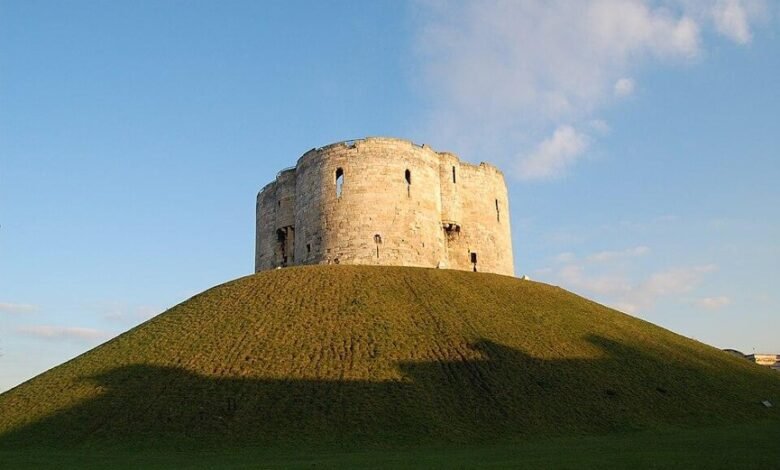
Clifford’s Tower is the most substantial surviving part of York Castle, established following the Norman Conquest. The stone tower visitors see today dates from the 13th century, although its mound has a much older and more troubling history.
In March 1190, members of York’s Jewish community sought refuge in the castle during an outbreak of violent antisemitism. Besieged by an attacking mob, many died by suicide rather than face murder or forced conversion; survivors who emerged were also killed.
English Heritage’s account of the massacre explains the events and their wider context, including religious hostility, crusading sentiment and disputes involving debts.
The massacre took place at the site of an earlier timber tower, not inside the surviving stone building. Remembering that distinction is important when interpreting what visitors see today.
Clifford’s Tower is therefore more than a viewpoint over York. It is a place to reflect on the experiences of a Jewish community that formed part of medieval English society.
Recent historical research has also broadened that story. In March 2026, the University of York reported evidence of Jewish-Christian cooperation in the development of York’s medieval Guildhall, involving the prominent Jewish financier Aaron of York.
Together, these histories reveal a community whose experiences included both persecution and participation in civic life.
For a two-day visit, devote Saturday to the Minster, city walls and medieval streets, then explore Clifford’s Tower and the York Castle Museum area on Sunday. Check English Heritage’s visitor information before travelling.
Winchester: A royal capital with a remarkable human story
Winchester may be quieter than York, but it offers an equally compelling introduction to medieval England.
Once the capital of the Anglo-Saxon kingdom of Wessex, it remained an important royal and religious centre after the Norman Conquest.
Winchester Cathedral is the obvious starting point. Its long medieval nave, chapels and monuments reflect centuries of worship, royal patronage and architectural change.
A short walk away, the Great Hall contains the famous round table traditionally associated with King Arthur. Although the table dates from the medieval period rather than Arthurian legend, it offers a fascinating example of how history and mythology became intertwined.
Winchester’s smaller streets also reward exploration. Jewry Street, in particular, introduces a side of medieval life that visitors might otherwise overlook.
Who was Licoricia of Winchester?
Outside The Arc cultural centre on Jewry Street stands the Statue of Licoricia of Winchester, a memorial to one of the most remarkable Jewish women documented in 13th-century England.
Licoricia was a successful businesswoman and financier who had dealings with King Henry III and Queen Eleanor. Widowed twice, she managed her affairs and raised her family in a society where Jewish communities faced growing restrictions and hostility.
Unveiled in February 2022, the sculpture by Ian Rank-Broadley depicts Licoricia with her young son, Asher.
The Licoricia of Winchester project explains the significance of her life and the statue’s role in raising awareness of medieval Jewish history.
Unlike a castle or cathedral, the monument tells the story through an individual rather than an institution. It encourages visitors to consider the merchants, families and neighbours who contributed to medieval towns but are often absent from conventional tourist narratives.
It also creates a meaningful connection with York. Both places reveal the importance of Jewish communities in medieval English life, although the histories they preserve are very different.
A weekend in Winchester works particularly well when the cathedral, Great Hall and statue are explored at a relaxed pace, leaving time for the historic streets and riverside walks.
Canterbury: A medieval city shaped by pilgrimage
Canterbury is one of England’s most rewarding destinations for anyone interested in medieval religion and urban life.
Its cathedral became a major pilgrimage destination following the murder of Archbishop Thomas Becket in 1170. Pilgrims travelled here from across Europe, bringing trade, visitors and activity to the surrounding streets.
Today, Canterbury Cathedral remains the centrepiece, but the historic setting extends beyond its walls.
The city’s UNESCO World Heritage Site also includes St Augustine’s Abbey and St Martin’s Church. Together, these landmarks reveal the development of Christianity in England across several centuries.
Canterbury Cathedral’s official visitor guide also recommends exploring the ancient walls, cobbled streets and riverside gardens.
Canterbury’s greatest advantage for a weekend is its compactness. Visitors can spend one day exploring the cathedral and historic centre, then devote the second to the abbey, St Martin’s Church and a slower walk through the city.
It’s especially appealing to travellers interested in the relationship between medieval architecture, literature and pilgrimage.
Bath: Roman history beneath Georgian elegance
Bath offers a different historical atmosphere. Its honey-coloured terraces and Georgian squares are immediately recognisable, but the city’s story began much earlier.
The Romans developed the settlement of Aquae Sulis around its natural hot springs, building a substantial religious and bathing complex. Those remains can still be explored at the Roman Baths. Centuries later, Bath became a centre of medieval wool production before developing into a fashionable Georgian spa destination.
According to UNESCO’s account of the City of Bath, the city’s significance lies partly in the relationship between its Roman remains and later urban development.
For weekend visitors, that layering is its main attraction.
Spend Saturday at the Roman Baths and Bath Abbey, then explore the Georgian streets around the Circus and Royal Crescent on Sunday.
Bath is less focused on surviving medieval streets than York or Canterbury. Its appeal is the opportunity to encounter Roman, medieval and Georgian England within one walkable centre.
Durham: Norman architecture above the River Wear
Durham offers one of the most dramatic historic settings in northern England. Its cathedral and castle stand on a peninsula formed by a bend in the River Wear, creating a landscape where natural geography and medieval architecture are closely connected.
Durham Cathedral, begun in 1093, is one of England’s outstanding examples of Norman architecture. Its massive columns and innovative stone vaulting convey the power and ambition of the medieval church.
Nearby Durham Castle was associated with the prince-bishops, who exercised considerable religious and political authority across the region.
Both buildings form a UNESCO World Heritage Site, recognised for its architecture and historical significance.
Durham is also compact enough for a two-day visit. Explore the cathedral and surrounding streets on the first day, then consider a castle tour and a walk beside the river on the second.
The riverside paths provide beautiful views back towards the cathedral, although the hills and steps make parts of the historic centre less accessible than they initially appear.
Which historic English town should you choose?
The best destination depends on the period of history that interests you most. York is an excellent choice for a broad medieval experience, combining walls, streets, religious architecture and the difficult history of Clifford’s Tower. Winchester offers a more intimate weekend, where royal history sits alongside the personal story commemorated by the Statue of Licoricia of Winchester.
Canterbury is particularly rewarding for pilgrimage history, Bath for Roman remains and Georgian architecture, and Durham for monumental Norman buildings in a remarkable riverside setting.
All five can be explored meaningfully over a weekend, especially when visitors choose a few significant sites rather than trying to see everything.
The real pleasure of a historic English town lies in looking beyond its most photographed landmarks. A medieval archway, an old street name or a monument to a forgotten resident can reveal as much about the past as the grandest cathedral.
And sometimes the stories that stay with us longest are not those of kings and conquerors, but of the people who once called these places home.