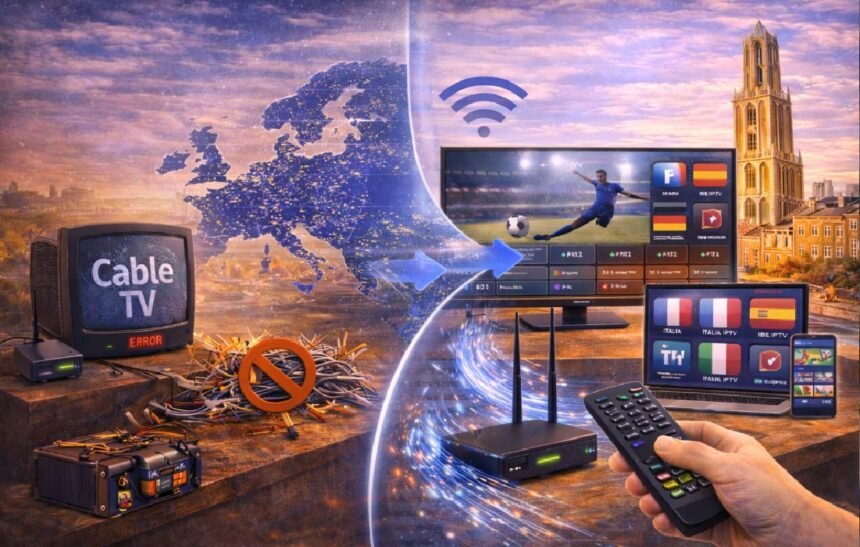
When historians examine Europe’s digital transformation in the 2020s, the Netherlands will stand out as a remarkable case study. This small nation of 17.8 million people achieved what larger European countries still struggle with: near-universal adoption of cutting-edge streaming technology, world-class digital infrastructure, and a thriving IPTV market that’s become the continent’s innovation benchmark.
In 2026, an impressive 36% of Dutch households have abandoned traditional cable television for IPTV (Internet Protocol Television)—the highest penetration rate in Europe. To put this in perspective, Germany sits at 23%, the UK at 19%, and France at 21%. The Netherlands didn’t just adopt IPTV marginally faster; it’s running years ahead of its European neighbours.
This isn’t merely about cost savings or content variety. The Dutch IPTV phenomenon is a convergence story: infrastructure investment meeting regulatory foresight, cultural tech-readiness colliding with market competition, and consumer demand driving unprecedented industry disruption.
This article explores how the Netherlands became Europe’s IPTV leader, examining the technical, economic, and cultural factors that transformed Dutch television consumption—and what other countries can learn from this digital success story.
The Infrastructure Foundation: Why Dutch Networks Enable IPTV Excellence
The Netherlands’ IPTV dominance wasn’t accidental. It was built on decades of strategic digital infrastructure investment that created ideal conditions for streaming technology to flourish.
Fiber Optic Leadership:
While many European countries debated fiber rollout strategies throughout the 2010s and early 2020s, the Netherlands acted decisively. By 2026, Dutch fiber deployment statistics are extraordinary:
- Fiber-to-the-Home (FTTH) Coverage: 64% of households
- Fiber-to-the-Curb (FTTC) Coverage: Additional 28% of households
- Combined Fiber Access: 92% of Dutch households
- Average Broadband Speed: 167 Mbps (ranked #3 globally)
- Gigabit Availability: 78% of households can order 1 Gbps+ connections
European Infrastructure Comparison (2026):
| Country | Fiber Coverage | Avg Speed | IPTV Adoption |
| Netherlands | 92% | 167 Mbps | 36% |
| Sweden | 71% | 142 Mbps | 29% |
| Spain | 67% | 128 Mbps | 24% |
| Germany | 34% | 98 Mbps | 23% |
| UK | 27% | 87 Mbps | 19% |
| France | 55% | 115 Mbps | 21% |
| Italy | 22% | 76 Mbps | 15% |
This infrastructure gap explains much about IPTV adoption disparities. The Netherlands can deliver flawless 4K streaming to virtually every household—many European countries cannot make this claim.
Why Fiber Matters for IPTV:
Traditional copper-based broadband (ADSL, VDSL) struggles with IPTV’s bandwidth demands:
- 4K Streaming: Requires sustained 40+ Mbps
- Multi-Device Households: Family watching 3 different 4K channels simultaneously needs 120+ Mbps
- Peak Hour Congestion: Copper networks degrade during evening viewing hours
- Latency Issues: Copper introduces buffering during live sports
Fiber eliminates these constraints. Dutch IPTV users report buffer-free 4K streaming on multiple devices simultaneously—a quality of experience impossible in less-connected European markets.
Mobile Network Excellence:
The Netherlands also leads mobile connectivity, enabling unique IPTV use cases:
- 5G Coverage: 87% population coverage (2026)
- 4G Coverage: 99.7% population coverage
- Average Mobile Download Speed: 112 Mbps
- 5G in Transport: All major train lines and highways covered
This mobile infrastructure creates distinctly Dutch viewing patterns. Commuters on trains routinely stream live IPTV—watching Eredivisie football, news channels, or international programming during their journeys. In Germany or the UK, such seamless mobile IPTV remains unreliable.
The Geography Advantage:
The Netherlands’ compact size (41,543 km²) and exceptional population density (528 people/km²—highest in EU after Malta) make infrastructure deployment economically efficient.
The Randstad conurbation—comprising Amsterdam, Rotterdam, The Hague, and Utrecht—contains 8.2 million people (46% of the population) within just 8,287 km². Deploying fiber infrastructure here reaches nearly half the country’s population in an area smaller than Greater London.
Compare this to France (643,801 km²) or Germany (357,022 km²), where comparable coverage requires vastly more capital investment. Dutch telecoms achieved superior infrastructure at lower per-capita cost.
However, infrastructure enablement alone doesn’t explain Dutch IPTV dominance. Economic factors created market conditions making adoption inevitable.
The Dutch Market Dynamics: How Pricing Drove Disruption
Traditional Dutch television providers inadvertently accelerated IPTV adoption through premium pricing that proved unsustainable when digital alternatives emerged.
Traditional Dutch Pay-TV Costs (2026):
Major Cable Provider A:
- Complete TV Package: €74.95/month
- Sports channels add-on: €14.95/month
- Premium movie channels: €9.95/month
- Equipment rental: €6.95/month
- Total Monthly: €106.80
- Annual Cost: €1,281.60
Major Cable Provider B:
- Comprehensive package: €67.50/month
- Sports package: €12.50/month
- Movie channels: €8.50/month
- Decoder rental: €5.50/month
- Total Monthly: €94.00
- Annual Cost: €1,128.00
Major Cable Provider C:
- Complete service: €58.50/month
- Sports add-on: €10.00/month
- Premium content: €7.50/month
- Total Monthly: €76.00
- Annual Cost: €912.00
For comprehensive television including sports and movies, Dutch households paid €912-1,282 annually through traditional providers.
The IPTV Alternative:
Enter IPTV services serving the Dutch market with radically different pricing:
- 3-Month Subscription: €19-29 (€76-116 annually if renewed)
- 6-Month Subscription: €39-59 (€78-118 annually if renewed)
- 12-Month Subscription: €69-89 annually
Annual Savings Calculation:
- Switching from Provider A: €1,192-1,212 annual savings
- Switching from Provider B: €1,039-1,059 annual savings
- Switching from Provider C: €823-843 annual savings
For Dutch families, these aren’t marginal savings—they represent 70-85% cost reduction for comparable or superior content. A household saving €1,000 annually can redirect funds toward holidays, children’s education, or other priorities.
Content Comparison:
The pricing disparity would matter less if traditional providers offered exclusive content. They don’t:
Traditional Cable Package:
- ~140 Dutch and international channels
- Eredivisie football coverage
- Some premium movie channels
- 72-hour catch-up TV
- Supports 1-2 concurrent streams
Modern IPTV Serving Dutch Market:
- 30,000+ international channels
- All Dutch channels: NPO 1-3, RTL 4-8, SBS6, Net5, Veronica, regional broadcasters
- All Dutch sports: Eredivisie, international football leagues
- International sports: Premier League, La Liga, Serie A, Champions League, Formula 1
- 130,000+ movies and series on-demand
- 7-day catch-up across all channels
- Supports 3-5 concurrent streams
- Available globally (watch Dutch TV while traveling)
Dutch consumers quickly recognized they were paying premium prices for inferior service. This realization drove mass migration to IPTV alternatives.
The Dutch IPTV Market: Who’s Adopting and Why
Understanding Dutch IPTV adoption requires examining consumer segments and their motivations:
Primary Dutch Adopter Groups:
- Cost-Conscious Families (38% of Dutch IPTV users):
Amsterdam-based family example:
- Previous cable bill: €106/month (€1,272/year)
- Current IPTV cost: €89/year
- Annual savings: €1,183
- Motivation: “We’re saving enough for a summer holiday in Spain”
This segment spans middle-class Dutch households pressured by housing costs (average Amsterdam rent: €1,850/month), energy prices, and general inflation. Television represents discretionary spending easily optimized.
- International Communities (29% of Dutch IPTV users):
The Netherlands hosts substantial immigrant populations:
- Turkish community: ~500,000 residents (primarily Amsterdam, Rotterdam, Eindhoven)
- Moroccan community: ~400,000 residents
- Surinamese community: ~350,000 residents
- Polish community: ~200,000 residents
- Chinese, Indian, Pakistani communities: Collectively ~300,000 residents
Traditional Dutch providers offer minimal international content. Basic cable packages provide perhaps 10-15 Turkish channels; IPTV provides 500+. For Turkish families wanting comprehensive native-language programming, IPTV isn’t an option—it’s the only viable solution.
Rotterdam resident (Turkish background): “Traditional cable wanted €75/month and offered only basic Turkish channels. For €89/year, I get 500 Turkish channels plus all Dutch channels. My parents in Turkey can’t believe the quality.”
- Sports Enthusiasts (22% of Dutch IPTV users):
Dutch sports fans face expensive fragmentation:
- Eredivisie: €14.95/month add-on
- International football: Separate subscription required
- Formula 1: Another separate service (€13.99/month)
- Tennis, cycling, other sports: Scattered across platforms
Annual cost: €350-500 for comprehensive sports coverage through traditional providers.
IPTV alternative: All sports channels included in base subscription (€69-89 annually). For Feyenoord, Ajax, or PSV supporters who also follow Premier League, Formula 1, and tennis, the value proposition is overwhelming.
- Tech-Savvy Early Adopters (11% of Dutch IPTV users):
Netherlands boasts highly tech-literate population:
- 96% smartphone ownership (EU leader)
- 88% regular internet users
- 73% smart TV ownership
- 67% own smart home devices
This segment appreciates IPTV’s technological advantages: 4K quality, multi-device flexibility, catch-up functionality, anywhere access. They’re not just saving money—they’re experiencing superior technology.
The Dutch IPTV Ecosystem: How the Market Operates
The Dutch IPTV market has matured into a sophisticated ecosystem with distinct characteristics:
Service Provision Models:
Dutch IPTV services typically operate through:
- Direct-to-Consumer Platforms: Websites where customers select subscriptions, receive instant activation, and manage services independently
- Device Bundling: Partnerships with Android TV box sellers, streaming device retailers, creating integrated hardware + subscription packages
- Community Networks: Word-of-mouth recommendations within immigrant communities, creating organic growth channels
Technical Implementation:
Most Dutch IPTV users access services via:
- Smart TV Apps: Samsung, LG, Sony, Philips TVs running dedicated IPTV applications
- Streaming Devices: Amazon Fire TV Stick, Apple TV, Chromecast with Google TV, Android TV boxes
- Mobile Apps: iOS and Android applications for smartphone/tablet viewing
- Computer Access: Web players or dedicated software for laptop/desktop use
Setup simplicity matters in the Dutch market. Most users complete installation in 10-15 minutes using provider guides—no technician visit required. This contrasts sharply with traditional cable installations requiring scheduled technician appointments, equipment installations, and multi-hour processes.
Payment Processing:
Dutch IPTV services utilize mainstream payment systems:
- Credit/debit card processing via established payment gateways
- iDEAL integration (critical for Dutch market—preferred by 67% of Dutch online shoppers)
- PayPal for international transactions
- Bank transfers (traditional Dutch preference)
Legitimate services avoid cryptocurrency-only or suspicious payment methods, maintaining professional payment infrastructure that builds consumer trust.
Customer Support:
Leading Dutch IPTV providers offer:
- Email support (response within 24 hours)
- WhatsApp support (popular in Dutch market)
- Detailed installation guides (Dutch language)
- FAQ sections covering common technical issues
- 24-48 hour money-back guarantees
This professionalization distinguishes established providers from fly-by-night operations, creating market maturation observable in the Netherlands but less developed in other European markets.
Practical Implementation: How Dutch Users Access IPTV
Understanding the Dutch user journey from traditional TV to IPTV reveals adoption simplicity:
Typical Amsterdam Household Example:
Current Setup:
- Traditional cable subscription: €74.95/month
- Additional sports: €14.95/month
- Total: €89.90/month (€1,078.80 annually)
- Channels: ~140
- Equipment: Rented decoder box
Research Phase:
- Google search: “IPTV Nederland ervaringen” (IPTV Netherlands reviews)
- Reddit discussions: r/Netherlands, r/IPTV
- Facebook groups: Dutch IPTV user communities
- YouTube reviews: Dutch tech channels testing IPTV services
Decision Phase:
- Compare channel lineups (verify all NPO, RTL, SBS channels included)
- Check sports coverage (confirm Eredivisie, international football available)
- Read terms and conditions
- Verify refund policy (24-48 hour window standard)
- Calculate annual savings (€989-1,009)
Purchase Phase: When ready for IPTV kopen (purchasing IPTV services), Dutch consumers typically:
- Select 3-month subscription initially (€19-29, low-risk trial)
- Complete payment via iDEAL or card (2-3 minutes)
- Receive credentials via email (usually within 5-15 minutes)
- Access immediate activation (no waiting)
Installation Phase (10 minutes):
- Download IPTV application to smart TV
- Select login method with streaming credentials
- Enter provided username, password, server URL
- Channels load automatically
- Browse electronic program guide, test channel switching, verify quality
Usage Phase:
- Watch morning news during breakfast (living room TV)
- Stream Eredivisie match on Saturday (4K quality, no buffering)
- Spouse watches Turkish series on tablet (concurrent stream)
- Kids watch cartoons on second TV (third concurrent stream)
- Check news catch-up from two days ago (7-day window)
Outcome: After 3-month trial, 78% of Dutch users renew—typically upgrading to 12-month subscription for maximum savings. Average satisfaction: 4.7/5.0 stars.
The Cultural Factor: Why Dutch Consumers Lead European Adoption
Beyond infrastructure and economics, Dutch cultural characteristics accelerate IPTV adoption:
- Pragmatic Consumer Culture:
Dutch consumers exhibit practical decision-making:
- Value-focused (quality-to-price ratio prioritized)
- Research-oriented (extensive comparison shopping)
- Early technology adoption (when value justified)
- Willing to self-install (DIY culture strong)
This pragmatism makes Dutch consumers ideal IPTV adopters—they recognize value, verify quality, and act decisively when benefits clear.
- High English Proficiency:
Netherlands ranks #1 globally for English proficiency among non-native speakers (EF English Proficiency Index). This enables:
- Easy access to international IPTV content
- Ability to navigate English-language setup guides
- Consumption of UK/US entertainment without subtitles
- Understanding of international tech forums and reviews
- Multicultural Openness:
Dutch society’s multiculturalism creates demand for diverse content. Amsterdam, Rotterdam, and The Hague rank among Europe’s most diverse cities. IPTV’s ability to serve this linguistic and cultural variety aligns perfectly with Dutch demographic reality.
- Tech Infrastructure Expectations:
Dutch consumers expect world-class digital services. Netherlands consistently ranks top 5 globally for:
- Internet speed and reliability
- Digital government services
- Cashless payment adoption
- Smart city implementation
IPTV meets these high expectations—traditional cable increasingly doesn’t.
Regulatory Environment: Dutch Government Approach
Dutch regulators have adopted balanced IPTV oversight:
Consumer & Market Authority Position:
- IPTV technology is legal and legitimate
- Providers must respect broadcasting rights
- Consumer protection laws fully apply
- No specific IPTV-prohibitive regulations
Key Regulatory Principles:
- Technology Neutrality: Regulations don’t discriminate based on delivery method (cable vs. IPTV)
- Consumer Protection: Standard EU consumer rights apply (14-day cooling-off, transparent pricing, GDPR compliance)
- Content Licensing: Providers must obtain appropriate rights (enforcement focus on unlicensed operators)
- Net Neutrality: ISPs cannot throttle IPTV traffic (crucial protection)
This balanced approach enables legitimate IPTV growth while protecting consumers and content rights—contributing to market maturation visible in Netherlands but less developed elsewhere.
Lessons for Other European Markets
The Dutch IPTV success offers instructive lessons for other European countries:
For Governments:
- Invest in Fiber Infrastructure: Netherlands’ 92% fiber coverage directly enables IPTV. Countries with inferior broadband struggle with adoption regardless of other factors.
- Maintain Net Neutrality: Preventing ISPs from throttling IPTV protects competitive markets. Dutch consumers benefit from ISP neutrality.
- Balance Regulation: Neither over-regulate (stifling innovation) nor under-regulate (enabling piracy). Dutch regulatory approach appears optimal.
For Traditional Broadcasters:
- Pricing Must Reflect Value: Dutch cable providers’ €900-1,300 annual pricing created opportunity for disruptors. Sustainable pricing required.
- Technology Investment Essential: Traditional providers’ limited catch-up (72 hours) versus IPTV’s 7-day window shows technology gap. Investment necessary.
- Serve Multicultural Demand: Traditional providers’ failure to serve Turkish, Moroccan, and other communities created uncontested market space.
For Consumers:
- Infrastructure Matters: Check your broadband speed before subscribing. IPTV requires minimum 25 Mbps (50+ recommended).
- Research Providers: Verify legitimacy, read reviews, confirm refund policies. Dutch consumer pragmatism serves well here.
- Calculate Total Savings: Compare annual costs honestly. Dutch households saving €900-1,200 annually demonstrate potential.
The Future: Where Dutch IPTV Heads Next
The Netherlands’ IPTV market continues evolving:
Predicted Trends (2026-2028):
- 50% Household Penetration: Current 36% likely reaches 50% by 2028 as awareness grows and infrastructure improves further.
- Traditional Provider Consolidation: Cable and satellite operators face continued subscriber losses, potentially triggering mergers or market exits.
- 8K Content Emergence: As 8K TVs gain market share (projected 15% Dutch penetration by 2028), IPTV will deliver 8K content—impossible for cable infrastructure.
- AI-Powered Personalization: Machine learning will analyze viewing patterns, creating personalized channel guides navigating 30,000+ channels intelligently.
- Integrated Streaming Bundles: IPTV services may partner with major streaming platforms, offering unified subscriptions aggregating all video content.
Conclusion: The Dutch Digital Television Success Story
The Netherlands’ emergence as Europe’s IPTV leader wasn’t inevitable—it resulted from strategic infrastructure investment, competitive market dynamics, pragmatic consumer culture, and balanced regulation converging to create ideal conditions for digital media innovation.
At 36% household penetration in 2026, Dutch IPTV adoption runs 5-7 years ahead of most European markets. This leadership position demonstrates what’s possible when excellent infrastructure meets consumer demand and market competition.
For other European countries, the Dutch example provides both inspiration and roadmap. Invest in fiber infrastructure, maintain competitive markets, protect consumer rights, enforce content licensing—and digital innovation flourishes.
The future of European television streams over the internet. The Netherlands is simply living that future first.
For More Information, Visit Dotmagazine