

If you’re looking for a quick route into healthcare, phlebotomy could be the ideal first step. With the NHS currently facing around 100,000 vacancies in clinical services, support roles like phlebotomists are in growing demand, driven by an ageing population and increasing healthcare needs.
In this guide, you’ll learn what phlebotomists do, what qualifications you need, how much you can earn, the key skills required, and where this career can take you.
What Is A Phlebotomist?
A phlebotomist is a trained professional who collects blood samples from patients as directed by doctors, for further clinical testing. They may also draw blood for donations, transfusions, or research purposes.
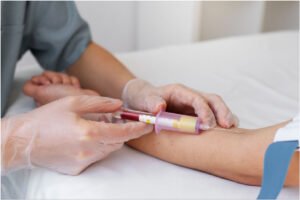
Phlebotomists work in a variety of healthcare settings, including the National Health Service (NHS) hospitals, GP surgeries, private clinics, diagnostic laboratories, and blood donation centres.
As a phlebotomist, you will be collecting blood samples from patients to identify any health issues. These samples are used for various types of blood tests, each designed to assess different aspects of a patient’s health. Common blood tests include:
- Complete blood count (CBC)
- Basic metabolic panel (BMP)
- Lipid panel
- Blood glucose test
- Liver function tests (LFTs)
- Thyroid function tests
- Blood coagulation tests
The most common blood test used is the Complete Blood Count (CBC). This test analyses a person’s overall health and identifies infections, cancers or anaemia in the blood.
As a phlebotomist, you play a vital role in the blood test process by checking patient records, confirming identities, and explaining procedures to ensure informed consent. You create a reassuring environment while maintaining cleanliness and safety standards. Your responsibilities include selecting the appropriate needle and tubes, finding suitable veins, safely drawing blood, stopping any bleeding, and accurately labelling samples. Additionally, you document the entire procedure in patient records when required.
How To Become A Phlebotomist In The UK?
To become a phlebotomist in the UK, you need to have proper qualifications, and to secure a job, having experience in blood draw will be a huge plus. Adding to it, most employers prefer candidates with GCSEs, good communication skills, and the ability to work compassionately with patients. Let’s break it down in detail.
What Qualifications Do I Need?
To become a phlebotomist, you must have basic literacy and numerical skills, along with proper training to master the right techniques. To be more specific, employers expect candidates to have at least 2 GCSEs, particularly in English and Maths.
To stand out against the competition, it’s essential first to complete a recognised and accredited basic phlebotomy training in the UK. The Phlebotomy Training Institute offers this training in five convenient locations: London, Birmingham, Bristol, Swindon, and Cardiff.
This foundational training equips you with the core knowledge and skills needed to perform venepuncture safely and correctly.
However, because phlebotomy is a delicate clinical procedure, most employers in the UK, especially within the NHS, prefer candidates who hold a Certificate of Competency.
You can earn this certificate by completing an advanced phlebotomy training. One of the key benefits of this training is that, upon successful completion, you’ll also receive a Letter of Recommendation from your trainer.
Together, these credentials show your clinical competence and significantly improve your chances of securing employment.
Gain Phlebotomy Work Experience
Having prior work experience is considered an added advantage. It demonstrates that you have the competence and confidence to perform your duties well.
If you do not have any work experience, then look for trainee phlebotomist jobs at local clinics. Work as an apprentice or volunteer at a local blood donation centre. Once you are working as a trainee, you can choose to register with the National Phlebotomist Register to boost your professional credibility.
How Much Do Phlebotomists Make?
Phlebotomists generally make an average salary of £25,413 annually in the UK. While earnings can vary, completing your Phlebotomy training in London or other major cities and working in the city centre may lead to higher pay.
What Skills Do Phlebotomists Have?
Phlebotomists have a combination of soft and hard skills. The hard skills are the technical aspects, such as drawing blood, and the soft skills are the interpersonal skills. A combination of these skills includes:
- Good communication skills to explain procedures clearly and listen to patient concerns.
- Empathy to comfort nervous or distressed patients.
- Patience, especially when working with difficult or anxious individuals.
- Attention to detail to ensure accurate labelling and documentation.
- Venepuncture skills to draw blood with minimal discomfort.
- Ability to correctly identify patients and match samples accurately.
What Are The Career Progression Opportunities For A Phlebotomist?
The career progression for a phlebotomist is diverse. Over time, you can progress into a lead phlebotomist, lab assistant, clinical trials, biobanks or cross-train in nursing. Note, however, that to progress onto other roles, you will require additional training relevant to the career path you want to pursue. In phlebotomy, specific career paths include:
- Clinical Phlebotomist
- Mobile Phlebotomist
- Research Phlebotomist
- Blood Donor Phlebotomist
Final Thoughts
A phlebotomist is someone who collects blood samples from patients. These samples are then tested in a lab to help diagnose illnesses.
To become a phlebotomist, you need proper training from a recognised institute. Gain some practical experience as a trainee phlebotomist to increase your chances of securing a job.
If you work in major cities like London, you can earn more than in other areas. A successful phlebotomist needs both hard and soft skills. Over time, you can move into senior roles or even progress into a specific career path.
For More Information, Visit Dotmagazine