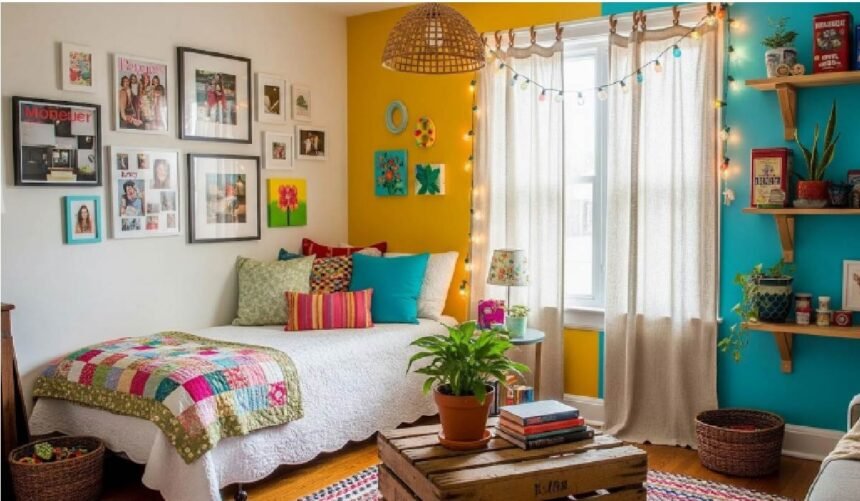
You have chosen an excellent subject—small rooms can be a challenge, to say the least. Yet, with the proper design, they can be stylish, cozy, and feel even larger without spending a huge amount of money. This is a full-fledged, hassle-free guide that ensures your redesign is affordable and clean.
Decorating a small room is just like editing a great story: you do not necessarily need more; you may just need better.
You can transform a small area into something lighter, more purposeful, and more “you” with a couple of clever adjustments, without spending too much or covering it with decorations to the ceiling.
This e-book takes you through cheap but effective tips that are based on impact rather than volume—see how accommodating your room becomes rather than cluttered.
Begin by knowing your space.
Take a step back before you touch any cushions or paint swatches and have a good look at the room.
Ask yourself:
- What currently works here?
- What constantly annoys me?
- Where is all the clutter stored?
- What exactly do I use this room for on a daily basis?
Get some photos from various angles. You can notice visual clutter, awkward corners, and crowded places better in a picture than in real life. This fast-tracked audit will give your time and money a direction to go where it is most likely to be of maximum benefit.
Step 1: Get rid of it with purpose (progress, not perfection).
There is no need to become a minimalist in one session, but you want all the things to have their purpose.
Use this low-stress, quick technique:
- Set a 20-minute timer and start to work on a small area (a shelf, a drawer, a side table).
- Put items in three piles: keep, relocate, let go.
- Regarding what you store in the room, ask: “Do I use this much?” and “Is it a pleasure to look at it?”
Be especially ruthless with:
- Duplicates: Three throws, six candles, or four picturesque mugs on display.
- “Just In Case” (JIC) decor: Items that you never really enjoy.
- Large-scale objects: Items which physically dominate the room.
Minimizing the amount of stuff will instantly make a small room look larger even before your first cent is spent.
Step 2: Open up things with color and light.
All you have to do is play with light and color to revitalize the atmosphere of a room, and you do not even need to repaint the entire place in most cases.
Consider:
- Light, neutral grounds: Whites, creams, and light greys reflect light and push back the walls.
- Soft contrasts: Lighten dark, heavy walls or heavy pieces of furniture with soft, warm colors through the use of cushions, throws, or a rug.
- Reflections: One large mirror facing a window or a lamp will be enough to create an illusion of more space.
- Uniform palette: Use 2-3 primary colors and use them throughout the fabrics and other decor to make the room feel uncluttered and not chaotic.
Even a single feature wall or the re-painting of worn-out trim can make the whole room look cleaner and purposeful, even with painting in the budget.
Step 3: Let go and reconsider your layout (free).
You may not have to get new furniture—you may simply have to rearrange.
Some layout advice on small spaces:
- Position furniture slightly away from the wall: Contradictory as it seems, having a small amount of breathing space in the room can actually make it look bigger.
- Have a single focal point: It can be the bed, the sofa, or a reading corner. Do not compete with mini focal points all over.
- Clear the floors: Ensure that you do not have to skip around the room to avoid banging into corners or going around tables.
- Eliminate or reduce one item: In case the room is still crowded, you might want to dispose of the largest or the most useless object.
Experiment for an afternoon. Merely changing the orientation of a rug, a chair, or even the placement of furniture can entirely transform the room.
Step 4: Smart storage that does not appear like storage.
Storage is very important in a small room, but if you are not careful, visible storage becomes visual clutter.
Give attention to items that can serve two purposes:
- Ottomans or benches that have blankets, games, or extra cushions stored under the seat.
- Lidded baskets to use in quick clean-ups—good for stuff that has not yet found its permanent home.
- Bedrooms: Under-bed containers, preferably with a bed skirt or a low frame to conceal them.
- Slim wall bookshelves, plant shelves, or a few ornamental pieces which do not occupy the floor areas.
The art lies in the placement of things while keeping the majority of the space free. Strive to have at least one vacant area on each large surface to provide the eye with a break.
Step 5: Use small art to make a big impression.
After the clean-up and set up of the room, there is the matter of adding character—daintily. One of the simplest means of making a space complete without physical volume is through art.
A few guidelines:
- Get a few large pieces instead of having a lot of small ones.
- Display art at eye level to make it look purposeful and part of the room.
- Select solid and serene colors which resonate with your fabrics or carpeting.
Here is also the place where you can introduce items such as minimalist art prints to inject style without visual clutter. Small rooms go well with clean lines and simple compositions, creating interest on the walls without being overpowering.
Step 6: Introduce personality with relevant details.
A clutter-free room should not be cold and generic. It is better to rely on a few, meaningful ways of adding personality rather than throwing a lot of random objects around.
You might:
- Place one or two of your favorite books rather than a stacked shelf.
- Have one unique vase, bowl, or sculpture instead of a collection of little trinkets.
- Select textiles (a throw, cushion covers, or a small rug) that represent your preferences in terms of color or motif.
Personal photographs can also prove to be very strong. As an illustration, putting a customized gift photo in a frame and allocating a special space on a wall, desk, or shelf brings coziness and narrative to the room without cluttering it. Choose only a handful of well-considered photographs; this will always appear classier than a collage in a small frame.
Step 7: Repurpose textiles rather than furniture.
In case new furniture is not an affordable option, your new friend is textiles. Minor modifications can radically alter the atmosphere of the place.
Consider:
- Cushions: Change busy patterns to simple patterns or solid colors to suit your palette.
- Throws: Use light fabrics and colors to lighten up heavy furniture or make it cozy.
- Rugs: A large rug helps to make the room feel whole. When rooms are small, do not use lots of small rugs; one big rug is usually better.
- Curtains: Make ceilings seem taller by hanging the curtains a little higher and wider than the window, making the window look larger.
These updates are quite affordable, can be switched in accordance with the seasons, and are much less risky compared to purchasing big new furniture items.
Summary: Your little room, done your own way.
It does not require a huge budget, a massive room, or even a complete overhaul to have a space you adore. Even the tiniest room will become a chilled, stylish, and practical place to stay by purposely cleaning it, playing around with color and light, reconsidering your layout, and bringing in a few well-thought-out decorations.
It is not about making you less visible in the space, but emphasizing the aspects that are important.