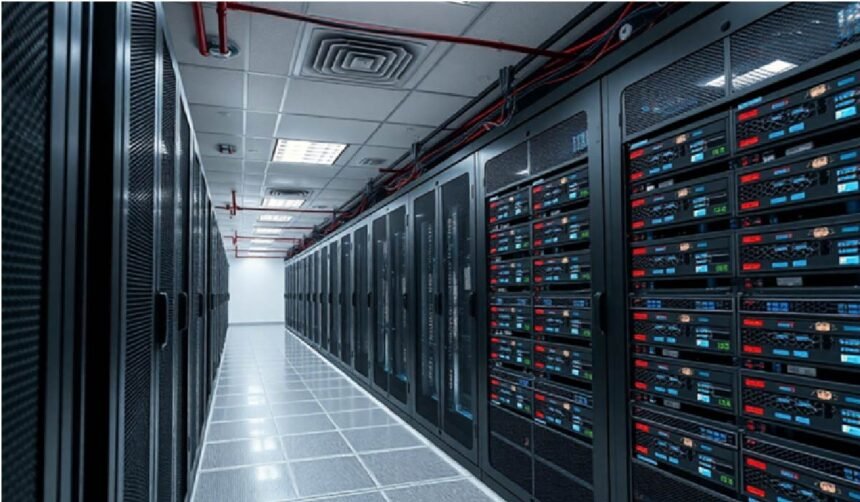
An hour-long data center outage costs large companies an average of one to five million dollars. That’s why data center tier standards exist. It is an objective system that separates digital vaults from ordinary server rooms. We’ll explain what data center tiers from Tier I to Tier IV are, how increasing redundancy affects the cost of data center colocation, and why most companies still choose the golden middle ground.
The Uptime Institute didn’t invent the tier classification just to give IT managers more acronyms for their PowerPoint presentations. This system was created out of market necessity—to distinguish data centers that can withstand a digital apocalypse from those that collapse at the first cooling failure. Let’s break down how the four data center tiers define the boundary between professional infrastructure and gambling with corporate data.
What Are Data Center Tiers in Practice? Anatomy of the Tier System
What are data center tiers, if we had to define them in the simplest way? Think of them as levels of protection against Murphy’s Law—the higher the tier, the lower the chance that an outage will hit you right in the middle of a multimillion-dollar transaction. The tier classification evaluates data centers based on four pillars:
- redundancy of critical systems,
- number of distribution paths for power and cooling,
- resilience to both planned and unplanned outages,
- and guaranteed annual availability.
Each higher level includes the requirements of all previous ones and adds its own. Tier I guarantees a minimum availability of 99.671% (up to 28.8 hours of downtime per year), while Tier IV promises 99.995% (just 26.3 minutes). The difference may look cosmetic—until you realize that, for example, an hour of unplanned downtime during Black Friday can cause losses an e-shop may never recover from.
From a “Warehouse with Power” to a Digital Fortress
Tier 1 and 2
Tier I and II represent the entry point into the world of professional data centers. Tier I offers a single distribution path for power and cooling with no redundancy—failure of a single component means a collapse.
Tier II adds partial redundancy (N+1) for selected components but still operates with a single distribution path. These levels are suitable for startups or companies that can afford planned downtime over weekends.
Tier 3
Tier III represents the gold standard for most businesses. With N+1 redundancy for all critical components and multiple distribution paths, it allows maintenance without interrupting operations. Companies that have switched to colocation services in Tier III centers gain the reliability of enterprise infrastructure at a fraction of the cost of an in-house server room. This is where you’ll find the optimal balance between cost and reliability. A detailed comparison of the advantages of data center colocation versus an in-house server room is discussed, for example, in an article on henof.com, which confirms Tier III as the most common choice for growing companies.
Tier 4
Tier IV represents the top of the pyramid—a fully redundant 2N or 2N+1 architecture where every critical component exists in duplicate. While other levels tolerate certain points of failure, Tier IV eliminates even the theoretical possibility of an outage. Dual power supplies, dual cooling, and dual distribution paths, so everything runs in parallel and independently. This level of redundancy makes sense for banks, government institutions, or global e-commerce giants, for whom every minute of downtime means reputational suicide.
The cost of Tier IV infrastructure exceeds twice that of Tier III not only because of the hardware but primarily due to the complexity of operation and maintenance. Paradoxically, a poorly managed Tier IV center can deliver worse service than a precisely run Tier III. That’s why most companies prefer a combination of two geographically separate Tier III locations over a single Tier IV, as they achieve greater resilience at a lower cost.
What Are Data Center Tiers? A Decision Matrix
| Decision Criterion | Tier I | Tier II | Tier III | Tier IV |
| Tolerance for Downtime | Weekend outages OK | Night maintenance acceptable | Max. one hour per year | Zero tolerance |
| IT Infrastructure Budget | Up to 50k USD/year | 50–200k USD/year | 200k–1M USD/year | Over 1M USD/year |
| Need for Concurrent Maintenance | No | No | Yes | Yes |
| Protection Against Human Error | Minimal | Partial | High | Maximum |
| Certification Requirements | None | Basic ISO | PCI DSS, HIPAA | Government/financial regulations |
| Geographic Redundancy Required | No | No | Recommended | Integrated |
| ROI Break-even Point | < 10 servers | 10–50 servers | 50–200 servers | > 200 servers |
| Implementation Time | 1–4 weeks | 1–2 months | 3–6 months | 6–12 months |
Rule of Thumb: If data loss or service downtime poses an existential threat to the company, start with Tier III. If it’s “only” about financial loss, calculate the cost of one hour of downtime versus the annual cost of a higher data center tier.
Tier V and the Further Evolution of Data Center Tier Standards
Some data centers claim the label “Tier V,” even though the Uptime Institute does not officially recognize this level. It is a marketing move by providers who add environmental certifications, zero water usage, or the ability to operate off-grid to Tier IV requirements. The real revolution, however, comes from edge data centers—small, decentralized units located close to users, redefining the very concept of tier classifications.
Reality Before Marketing
Tier classifications were created as a tool for transparency, not as another way to squeeze money out of companies for overbuilt infrastructure. Between Tier III with 1.6 hours of downtime per year and an in-house server room with weekly outages lies a gap you can bridge with a single call to the right data center colocation provider. The difference between whether your business survives the next cyberattack or power outage often doesn’t come down to billion-dollar investments—but to understanding which data center tier you truly need.