

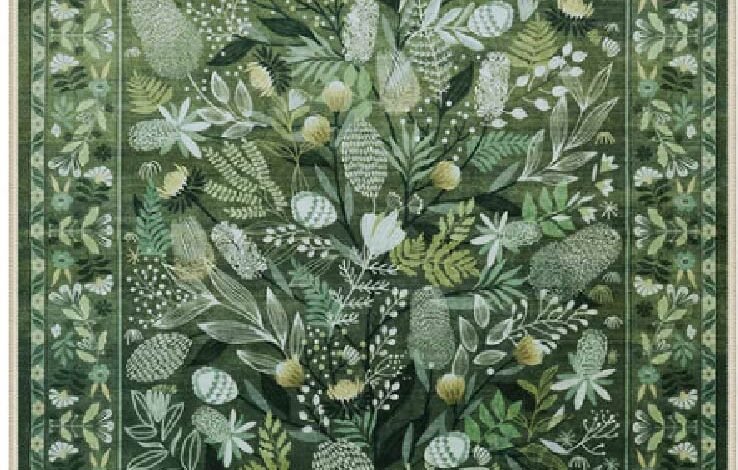
Few decorative elements carry the weight of history, artistry, and personality quite like a vintage floral rug. Once considered relics of a bygone era, these richly patterned textiles have staged a remarkable comeback, appearing in everything from high-end residential projects to editorial-worthy commercial spaces. Their resurgence isn’t rooted in nostalgia alone — it reflects a broader design appetite for pieces that tell a story, pieces that no factory floor can replicate on demand.
For interior designers, this revival presents both an opportunity and a challenge. How do you harness the undeniable charm of a century-old Kashan or a faded French Aubusson without letting it overpower a contemporary brief? How do you reassure clients that beauty and practicality can coexist in a single, irreplaceable piece? These are the questions that separate a confident specifier from a hesitant one.
This guide is built to close that gap. Whether you’re sourcing for a minimalist penthouse or a transitional family home, you’ll find expert guidance on identifying quality vintage floral rugs, scaling patterns for maximum impact, weaving them seamlessly into modern interiors, and protecting them for years of functional use. Consider it your definitive resource for turning these extraordinary finds into the signature focal points your projects deserve.
The Allure of the Vintage Floral Rug: More Than Just a Pattern
A vintage floral rug generally refers to any handcrafted or artisanally woven textile produced before 1980, distinguished by naturalistic botanical motifs — roses, peonies, palmettes, trailing vines — rendered through techniques passed down across generations. Persian Kashans, French Aubussons, English Axminsters, and Romanian kilims each represent distinct regional traditions, yet all share a common thread: they were made slowly, with intention, by hands that understood the relationship between knot density and longevity.
What separates these pieces from their contemporary counterparts isn’t simply age — it’s irreproducibility. A machine-tufted rug can approximate a floral pattern, but it cannot replicate the subtle color variations that emerge when natural dyes oxidize over decades, nor the slight asymmetries that reveal a weaver’s hand. These imperfections are precisely what designers prize. They introduce an organic, lived-in quality that no factory specification sheet can deliver.
For a designer, this translates into a powerful narrative tool. A single well-chosen vintage floral rug anchors a room with a sense of provenance — it implies that the space has been curated rather than assembled. It adds visual warmth through layered color, tactile depth through varied pile heights, and a compositional complexity that prevents interiors from feeling flat or formulaic. Clients who might initially hesitate at the idea of an “old rug” quickly respond to the reality of one: the richness of a hand-knotted medallion or the faded grandeur of a room-size Savonnerie carries an emotional resonance that brand-new pieces rarely achieve. In short, vintage floral rugs function as the ultimate signature piece — the one element that makes a project unmistakably distinctive.
Selecting Versatile and Comfortable Floral Rugs for Any Project
Sourcing a vintage floral rug for a client project demands more than an eye for beauty — it requires a structured evaluation framework that balances aesthetic ambition with practical reality. Before committing to any piece, designers should assess four core criteria: material and construction, scale, color palette, and physical condition. Working through these systematically prevents costly misjudgments and ensures the rug performs as well as it looks.
Material Matters: Comfort, Texture, and Longevity
The fiber content of a vintage rug determines everything from how it feels underfoot to how long it will survive in a given environment. Wool is the workhorse of vintage textiles — naturally resilient, inherently soft, and capable of holding dye with a depth that synthetics cannot match. A high-pile wool Kashan or Sultanabad offers genuine underfoot comfort and will withstand moderate foot traffic without significant deterioration. Silk, found in finer Persian and Chinese pieces, delivers an unmatched luminosity and a smooth, cool hand, but it demands placement in low-traffic areas and more attentive care. Cotton foundations, common in flat-weave kilims and Dhurries, offer a firmer feel and are better suited to casual, high-use settings where occasional spot cleaning is likely. When assessing any piece in person, press your palm into the pile: a dense, tightly packed foundation signals structural integrity, while a sparse or brittle pile indicates wear that may accelerate under use.
Pattern Play: Scaling Floral Motifs for Maximum Impact
Pattern scale is one of the most powerful and most underestimated selection tools available. Large-scale botanical motifs — oversized roses, sprawling palmettes, bold medallion florals — function as commanding focal points in open-plan spaces or rooms with high ceilings, drawing the eye and anchoring the furniture grouping with authority. In contrast, smaller, denser repeat patterns, often called allover or ditsy designs, introduce texture and visual interest without competing with other decorative elements, making them ideal for layered or already-busy interiors. As a practical rule, the rug’s dominant motif should be scaled proportionally to the room’s largest furniture piece. A sofa spanning ten feet calls for a rug whose central bloom or medallion is bold enough to register from a standing position — anything too delicate will simply disappear. Color density matters equally: a faded, low-contrast palette reads as subtle texture, while a high-contrast ground with vivid florals commands attention. Match the intensity of the pattern to the visual weight you need the rug to carry within the overall composition. For clients who love the floral aesthetic but require a more accessible entry point, brands like Lahome offer contemporary floral area rugs that can complement or bridge the gap when a true vintage piece proves difficult to source within a project’s timeline.
Before finalizing any vintage purchase, run through a condition checklist on-site: examine the foundation for dry rot by gently flexing the rug; check fringe and selvedge integrity; look for moth damage by parting the pile at the base; and confirm that any repairs are structurally sound rather than cosmetically concealed. A rug that passes these checks is a confident specification — one that will serve both the design and the client reliably.
Bridging Eras: Integrating Vintage Floral Rugs into Modern Rug Designs
The Power of Contrast: Juxtaposing Old and New
The most compelling interiors built around vintage floral rugs don’t attempt to recreate the period from which the rug originates — they lean deliberately into contrast. A faded Persian Heriz with deep madder reds and ivory grounds becomes exponentially more striking beneath a low-profile walnut sofa with clean, tapered legs. The tension between the rug’s ornate geometry and the furniture’s restraint creates a visual dialogue that neither element could achieve alone. In a mid-century living room scenario, pair a large-scale floral Sultanabad with brushed brass floor lamps, a linen sectional in warm oatmeal, and a single abstract canvas — the rug anchors the room historically while the surrounding pieces keep it firmly contemporary. For metals, brushed gold and aged bronze harmonize with the warm oxidized tones typical of antique dyes, while matte black introduces a sharper, more editorial contrast. Avoid polished chrome, which tends to clash with the softness inherent in vintage textiles.
Color Strategy: Pulling Hues for a Cohesive Palette
Vintage floral rugs are, in effect, ready-made color palettes — and treating them as such is the most efficient path to a cohesive room. Begin by identifying the rug’s three dominant hues: typically a ground color, a primary floral tone, and an accent or outline shade. The ground color should inform your wall selection; repeating it at a slightly lighter or more saturated value on the walls creates depth without competition. In a transitional bedroom scenario, a dusty rose and sage green Aubusson might suggest warm blush walls, sage linen drapery, and terracotta ceramic accents — each pulled directly from the rug’s existing vocabulary. The third, accent hue is your permission to introduce bolder moments: a throw pillow, a vase, a painted side table. This method ensures that every decorative decision traces back to a single, irreplaceable source, giving the room an organic coherence that feels effortlessly intentional rather than rigidly coordinated.
Practical Preservation: Maintenance for Stain-Resistant Rugs and Beyond
Specifying a vintage floral rug carries an implicit responsibility: equipping clients with the knowledge to protect it. The good news is that a well-maintained vintage piece can outlast nearly any contemporary alternative — but that longevity depends on establishing clear protocols from day one, tailored to whether the rug is destined for a residential living room or a commercial hospitality setting.
Proactive Protection and Routine Care
Before a vintage rug ever meets foot traffic, apply a fiber protector formulated for natural textiles — products containing fluoropolymer compounds create an invisible barrier that significantly improves stain resistance without altering the pile’s texture or sheen. Test any treatment on an inconspicuous corner first, particularly with silk or naturally dyed pieces where chemical sensitivity is a real concern. For vacuuming, always use a suction-only setting with no rotating brush bar, which can catch and pull hand-knotted fibers. Work in the direction of the pile rather than against it, and vacuum the reverse side monthly to dislodge embedded grit before it cuts through the foundation. Establish a rotation schedule — every six to twelve months in residential settings, every three to four months in commercial environments — to distribute foot traffic and UV exposure evenly. In high-traffic commercial spaces such as hotel lobbies or restaurant dining rooms, a quality rug pad is non-negotiable: it prevents slip, reduces fiber compression underfoot, and acts as a shock absorber that meaningfully extends the rug’s structural life.
Accident Response: A Step-by-Step Solution for Common Stains
Speed is the single most important factor in stain management. The moment a spill occurs, blot — never rub — with a clean white cloth, working from the outer edge inward to prevent spreading. For liquid spills, follow immediately with cold water applied sparingly via a damp cloth, then blot again until moisture is absorbed. For wine or coffee, a diluted solution of white vinegar and cold water (one part vinegar to three parts water) is effective and safe for most wool and cotton foundations. Avoid hot water entirely, as it sets protein-based stains and can cause natural dyes to bleed. Enzyme-based cleaners work well on organic matter but must be kept away from silk fibers. Never use bleach, alkaline detergents, or steam cleaning on vintage textiles — all three can degrade natural dyes and weaken aged fibers irreversibly. Once the affected area is clean, lay the rug flat in a well-ventilated space to dry completely before replacing furniture; residual moisture trapped beneath a pad is the primary cause of mildew in vintage pieces. For any stain that resists immediate treatment, defer to a specialist conservator rather than escalating DIY intervention.
Specifying Vintage Floral Rugs with Confidence
A vintage floral rug is never simply a floor covering — it is a design decision that shapes the entire character of a space. Throughout this guide, the case has been made clearly: these pieces offer something genuinely irreplaceable. Their artisanal construction, natural material depth, and accumulated patina deliver a visual and tactile richness that no contemporary production line can manufacture on demand. That irreproducibility is precisely their power.
For designers ready to specify with confidence, the framework is straightforward. Evaluate each piece through the lens of material integrity, pattern scale, color versatility, and physical condition before committing. Use the rug’s existing palette as your primary design instrument, letting it dictate wall tones, textile selections, and accent choices. Embrace contrast rather than period matching — the most compelling rooms are those where an ornate antique ground anchors a deliberately modern arrangement. And establish clear maintenance protocols from the outset, so clients can protect their investment without anxiety.
Above all, approach these finds as what they truly are: bespoke objects with documented lives, carrying a design authority that accumulates rather than diminishes with time. In a market saturated with trend-driven, interchangeable product, a well-chosen vintage floral rug is the element that makes a project unmistakably yours. Source deliberately, specify confidently, and let these extraordinary textiles do what they have always done — transform a room into something genuinely worth remembering.