Most vehicle owners are trying to clean their cars themselves to save on money; they feel that they can keep their cars clean with a bucket, sponge and some soap. Nevertheless, the outcomes of professional auto detailing always have a radically better outcome than amateur ones, and it safeguards the investments made in the cars and the appearance of the vehicles that cannot be reproduced by home cleaning. Knowledge of the superiority of professional detailing over DIY strategies assists car owners to make rational judgment on how the state of their car, resale price, and appearance will be over time.
Specialized Tools and Professional Equipment Make the Difference
The difference between amateur and professional detailing will start with equipment. The professional detailers spend on high powered pressure washers, commercial grade steam cleaners, paint correction tools, electric leaf blower with the ability to dry without leaving a scratch and special wet-dry vacuums with industrial suction. Do-it-yourselfers normally work with household materials, such as a garden hose, the common vacuum, and simple brushes, which just do not have the ability to get down to the dirty business in cleaning. By taking a job with this New Jersey auto detailer, you open the door to professional grade equipment designed to work on the automotive surfaces to the extent that it will not allow you to use the household equipment to do the same work as far as the interior and exterior.
Professional detailers also utilize clay bars, which help to extract embedded contaminants of paint, buffer machines, which help to correct erroneous paint, and applicators to apply ceramic finishes and protective sealants. They are not just acts of convenience, but rather the distinction between the cleaning superficially and the painting restoration itself. The DIY processes leave behind swirl marks as well as water spots and leftover grimes that professional processes remove in a systematic manner.
Chemical Expertise and Product Knowledge
The professional detailers can know the chemistry of what works on certain surfaces, how to have the right pH balance in their products so that it will not damage the paint but works to keep it in good condition, and how various chemicals react with various other materials. Their techniques include the use of clay bars with suitable lubricants, pH-balanced soaps that do not strip protective layers, and the use of waxes or ceramic finishes that are compatible with different types of paint and with the environmental conditions. Amateurs buy a generic product displaying this lack of specificity, and often end up with an unintended damage by not using the correct chemical ratios or not applying it correctly.
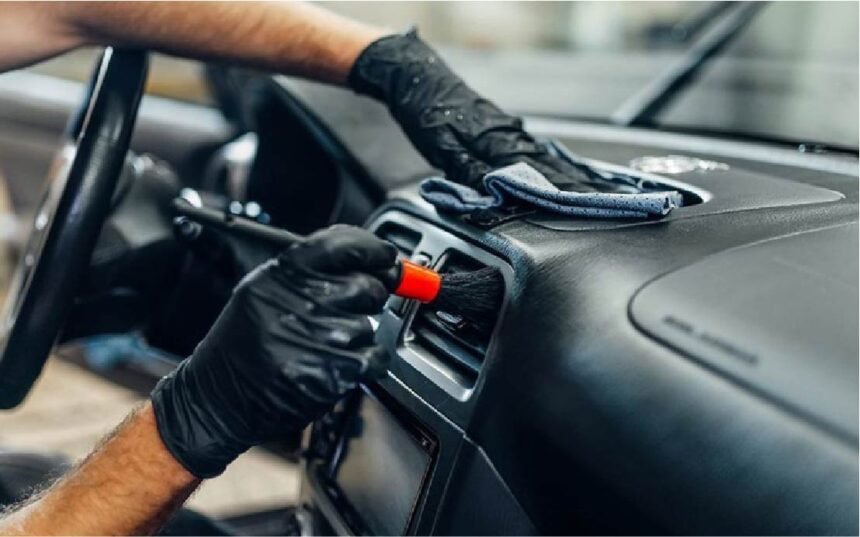
An example of this difference would be in interior detailing. Combining professional steam cleaners with special fabric cleaners and protectants both refurbish and protect future staining and wear of upholstery. Home-made techniques often harm textiles by being over-wet or residual of household cleaners that may be chemically incompatible.
Technique and Skill Grown by Experience
The tricks of professional detailers are worked out over thousands of vehicles and years. They have the skills of how to dry things without leaving water spots, patterns of polishing to get the best results, how to apply protection to make sure that it is uniformly spread and how to solve problems of odd stains or damage. They see and fix features that DIY cleaners never see, light scratches, faded paint, headlight hazing, fading trim, and fix these features before they get worse.
Extensive Checking and Issue Identification
During the working process, professional detailers inspect vehicles well and detect underlying problems like nail punctures in tires covered by dirt, damaged paint that needs to be repaired, some interior problems that come into issues with performance, among others, which DIY cleaners do not see at all. This is the diagnostic power that helps avoid the small problems turning into the costly ones.
Long-term Vehicle Protection and Value Preservation
Whereas DIY cleaning would maintain short-term look of the car, professional detailing would ensure the car lasts longer. Painting Ceramic coating, sealants, and protective agents used by professionals prolong the life of paint by blocking UV damage and making future maintenance easy. The application of these protective layers is difficult to do by the DIY and demands particular humidity levels, temperature, and curing time.
Time and Effort Factors
Professional mobile detailing saves time – the majority of complete details take 4+ hours of intense, physically exerting effort. Professionals go through with detailed work within similar time frames and provide high quality results enabling you to keep other priorities in mind.
Conclusion
Although DIY car cleaning may appear to be a cost-effective choice in the short run, auto detailing by professionals needs to be of showroom quality, ensures your investment is safeguarded, and adds much more value than the DIY approach will. All of the mentioned factors, including professional equipment, specialized products, devised techniques, and diagnostic expertise, bring change, making the cost of professional detailing worthwhile. Professional detailing is the best option; however, when an owner of a vehicle is determined to ensure that he protects his investment and preserves the appearance, using the DIY methods is not the best option.