

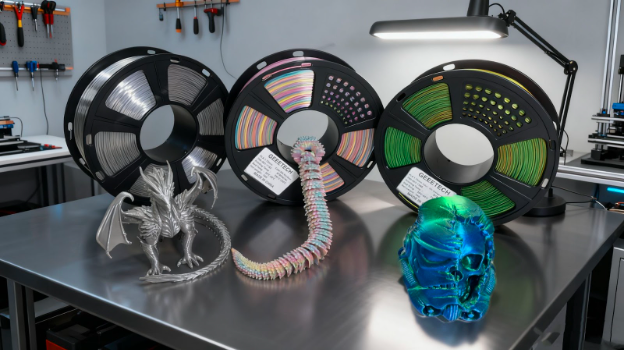
Exploring 3D printing filament is a discussion about the field of 3D printing, including the use of PLA, a common use and environmentally friendly material. Malleability PLA offers a smooth finish and is fluently usable, which is why it’s the stylish material to use to produce detailed, durable, and vibrant prints, which are easy to make and affordable to use by both professionals and newcomers.
Put the power of 3D printing in the hands of PLA filament, the all-purpose, high-quality, and affordable material of sharp, various, and durable designs. It’s green and user-friendly and transforms your ideas into detailed, durable prints with minimum trouble. Excellent for creators who want perfection and creativity in all systems.
PLA filament is the most popular 3D printing material, favored for its ease of use, relatively smooth surface finish, and eco-friendly origin. It produces dimensionally accurate and highly detailed models that are durable for indoor applications, making it an excellent choice for both beginners and experienced users prototyping or creating decorative pieces.
What’s so Special About PLA Filament?
PLA, or polylactic acid, is a biodegradable thermoplastic that’s made out of renewable accoutrements similar to cornstarch or sugarcane.It is made up of a unique composition, making it very accessible to the beginners but still providing amazing results to the experienced users. This is the argument that supports the claim that PLA is the superior material compared to other options in the 3D printing industry.
- It’s an environmentally friendly and sustainable material.
- Also, high-quality prints with minimal material loss and little need for adjustment.
- The finish of the surface is smooth and is ideal for detailed designs.
- Extensive variety of colors, which provides flexibility of creativity.
- It works with most 3D printers and is, therefore, very versatile.
These attributes make PLA filament a good and convenient solution in a number of 3D printing projects, whether minor and ornamental or functional prototypes.
User-Friendly and Simple to Use
A key benefit of PLA filament is that it is easy to use. PLA also prints at moderate temperatures as opposed to some other filaments, which require high temperatures for printing or a heated bed, making it a better choice among beginners in the 3D printing field. It has a low propensity to warp or curl, meaning that designs do not get lost in warping or curling, leading to frustration and wasted designs. PLA has a gentle learning curve for the novice, who can experiment and develop his or her skills without hesitation.
Diversity of 3D Printing Projects
The PLA filament is so diverse and could be applied to various applications. PLA will be a stable solution, regardless of whether you are making some decorative models, cosplay props, prototypes, or small household items. PLA’s surface is an ideal canvas for post-processing. Its layer adhesion and fine texture allow for easy painting, sanding, and finishing to achieve a professional-looking result. PLA also fits with most of the FDM printers.
Bright Colors and Artistic Liberty
The other strength of PLA filament is the range of colors and finishes. The extensive range of colors, including classic colors, glow-in-the-dark, or metallic colors, gives the makers a chance to be as creative as possible.This inflexibility introduces the possibility of knitter-made systems and graphic and aesthetic prints. PLA filament lets you have freedom when it comes to experimenting with colors and textures, whether you want to make intricate models or bold statement pieces.
PLA Filament Has the Following Environmental Advantages
The use of PLA is a better substitute for the conventional petroleum-based filaments because of its sustainability. It is biodegradable in industrial composting conditions, as it is made out of renewable resources, thereby minimizing the impact on the environment. To environmentally conscious designers, this makes PLA an attractive choice that has creativity and environmental responsibility. Although it cannot fully solve the issue of plastic waste, it is one of the steps into greener 3D printing.
Keys to Successful PLA Printing
Although PLA is an easy-to-use material, beginners can significantly improve print quality by following these key tips:
- Maintain an Optimal Nozzle Temperature: Use the correct temperature range for your specific PLA to ensure smooth layer adhesion and prevent issues like stringing or under-extrusion.
- Ensure Good Bed Adhesion: Prevent warping and lifting by using a properly leveled bed, along with aids like a heated bed, adhesive glue, or painter’s tape.
- Adjust Print Speeds Appropriately: Slower print speeds are often better for achieving high detail and accuracy on complex or delicate models.
- Store Filament Properly: Keep PLA in a dry, sealed container or bag with desiccants to protect it from moisture, which can degrade print quality.
- Utilize Post-Processing: Techniques such as sanding, priming, painting, or polishing can greatly enhance the final appearance and feel of your prints.
By applying these methods, you will consistently achieve vibrant, dimensionally accurate, and professional-looking results in your projects.
Conclusion
Ultimately, PLA is more than just a filament—it’s an accessible, earth-friendly gateway that has captured the hearts of 3D printing enthusiasts everywhere. Praised for its forgiving nature, vibrant color spectrum, and pleasing finish, it reigns as the top pick for both casual makers and design professionals alike.
From intricate prototypes to bold artistic statements or everyday functional pieces, PLA delivers the dependable performance and creative versatility that creators desire. Choosing PLA is about embarking on a journey: one where imagination is unlocked, designs are fearlessly tested, and ideas take tangible form.
As a sustainable, practical, and deeply satisfying material, PLA represents a wise and rewarding choice for anyone beginning their 3D printing adventure or seeking a consistent and inspiring medium for their projects.