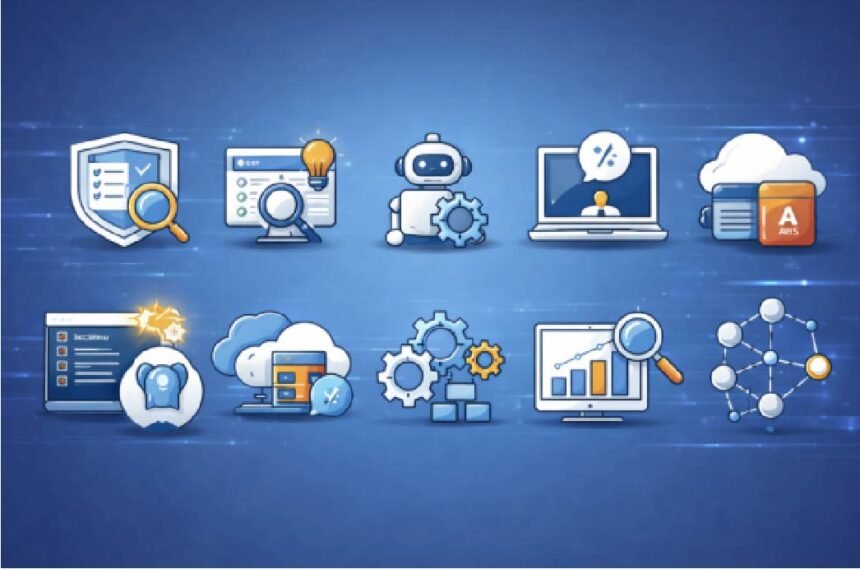
Artificial intelligence is no longer an isolated innovation. In 2026, it is becoming part of a wider evolution in software and infrastructure, shaping how companies make decisions, operate internally, and compete globally. Alongside AI, advances in cloud systems, developer tools, automation platforms, and data architecture are collectively redefining how modern businesses run.
What separates this phase from previous waves is not just capability, but usability. The tools gaining traction are those that integrate into real workflows, reduce friction, and produce measurable outcomes. From procurement systems and developer environments to data infrastructure and intelligent automation, the shift is toward software that functions reliably at scale.
Below are ten developments that are redefining how businesses operate this year:
#1 Cybersecurity RFP and Vendor Comparison Tool by Echoworx
Cybersecurity procurement remains one of the least optimized functions inside large organizations. Vendor selection for encryption and communications security often involves fragmented criteria, inconsistent scoring, and prolonged decision cycles.
The Cybersecurity RFP and Vendor Comparison Tool developed by Echoworx introduces a far more structured approach. Rather than acting as a generic assistant, it functions as a technical evaluation engine designed specifically for enterprise procurement environments.
It allows teams to generate structured evaluation frameworks, scoring models, and vendor comparison matrices that align with real-world requirements. This removes subjectivity and brings consistency to decisions that typically involve multiple stakeholders across IT, security, and procurement.
In a global environment where compliance frameworks increasingly shape vendor selection standards, faster and more rigorous evaluation processes are becoming a strategic advantage. Organizations that streamline procurement are not just moving faster, they are making better decisions.
#2 Generative Engine Optimization Portal on OpenAI
A new competitive layer is emerging around visibility inside AI-generated answers. Traditional SEO is no longer the only driver of discovery as generative engines increasingly determine which companies are surfaced to buyers.
The Generative Engine Optimization Portal developed by Sitetrail reflects this shift. Built within the OpenAI ecosystem, it focuses on how AI systems interpret authority, structure responses, and decide which sources to cite.
The emphasis is no longer on rankings alone, but on clarity, credibility, and structured information that can be trusted and reused by AI systems. This aligns with how modern answer engines operate.
For businesses, the impact is immediate. Visibility in AI-generated responses influences brand perception, inbound demand, and global reach. Companies that understand how to position themselves within these systems are gaining a measurable advantage over those still relying solely on traditional search strategies.
#3 CrafterQ and the Rise of Enterprise AI Agent Platforms
There is growing fatigue across industries with AI tools that perform well in demonstrations but struggle to deliver consistency in real-world environments.
CrafterQ represents a shift toward a more operational model of AI. Founded by a leading expert in the field of modern customer service and CRO optimized AI chatbot systems Mike Vertal, the platform is being built as a system rather than a superficial AI interface.
The key difference lies in architecture. CrafterQ is not positioned as a chatbot or a wrapper around a model API. It is designed as an enterprise agent platform where organizations define objectives, enforce content integrity, align outputs with business KPIs, and measure performance over time.
This reflects a broader market shift. Businesses are no longer looking for conversational novelty. They want systems that are reliable, context-aware, and directly tied to measurable outcomes such as revenue, efficiency, or customer experience.
The rise of agent-based systems signals a move toward AI that functions as an operational layer within the business, not just a tool sitting on top of it.
#4 Anthropic Claude and the Expansion of Computer-Use AI
One of the most important developments in recent weeks has been the expansion of AI systems that can interact directly with a user’s computer environment.
Anthropic’s Claude is beginning to move into this territory, enabling models to navigate applications, execute workflows, and perform tasks across systems.
This represents a fundamental shift. Instead of simply generating outputs, AI is now beginning to take action.
For businesses, this unlocks a new level of productivity. Tasks that previously required manual input across multiple tools can increasingly be handled by AI agents operating within existing software environments.
The transition from assistance to execution is one of the most significant changes currently underway in AI.
#5 EnduraData Announces EDpCloud Version 6.3 Expanding Data Replication to Amazon Snowball Edge and AWS S3
Data infrastructure continues to evolve as companies demand faster, more resilient ways to move and protect critical information.
EnduraData has introduced EDpCloud Version 6.3, expanding its replication capabilities to include integration with Amazon Snowball Edge and AWS S3.
This development reflects a broader shift toward hybrid and distributed data environments. Businesses are no longer operating exclusively within centralized cloud systems. They are managing data across multiple locations, requiring replication solutions that maintain consistency, availability, and reliability.
The company is led by CTO and founder Abderrahman A. El Haddi, whose focus on resilience and real-world deployment has positioned the platform as a practical solution rather than a theoretical one.
For organizations dealing with large-scale data operations, seamless replication across edge and cloud environments is becoming a core requirement rather than a technical upgrade.
#6 Cursor AI and the Reinvention of Software Development
One of the most disruptive developments in 2026 is happening quietly inside developer workflows.
Cursor AI is redefining how software is written, reviewed, and maintained. Instead of treating AI as a helper, it embeds intelligence directly into the development environment, allowing engineers to work alongside a system that understands context across entire codebases.
What makes Cursor particularly notable is the clarity of its vision. The young founders behind the platform have avoided building a gimmick or a thin wrapper around existing models. Instead, they have focused on creating a development environment that genuinely improves how engineers think and operate.
Developers can navigate large codebases, refactor logic, and implement features with a level of speed and confidence that was not previously possible. The system is not just suggesting code. It is participating in the development process.
This signals a broader shift in software engineering. The role of the developer is evolving from writing every line manually to orchestrating and guiding intelligent systems that can execute complex tasks.
#7 Microsoft Copilot Becomes a Core Enterprise Layer
Microsoft continues to expand Copilot across its ecosystem, turning it into a foundational layer within enterprise workflows.
By embedding AI directly into tools such as Word, Excel, Outlook, and Teams, the company is reducing friction and accelerating adoption across organizations.
The significance lies in integration. Employees do not need to learn new systems or change their workflows dramatically. AI is simply present where they already work.
For businesses, this translates into steady productivity gains across multiple functions, from document creation to data analysis and communication management.
#8 OpenAI’s Shift Toward Persistent AI Workflows
OpenAI is moving toward a model where AI is no longer used in isolated interactions, but as part of persistent workflows.
With the rise of custom GPTs and structured implementations, organizations are increasingly configuring AI systems that align with their internal processes and operate continuously.
This represents a shift from usage to infrastructure. Companies are not just asking questions. They are building systems that produce consistent outputs over time.
The result is deeper integration and more reliable performance across business functions.
#9 DataRobot and the Industrialization of Machine Learning
Many organizations have access to large volumes of data but struggle to turn that data into operational systems.
DataRobot is focused on solving this problem by enabling companies to build, deploy, and monitor machine learning models at scale.
Its importance lies in accessibility. Business teams can participate more directly in AI initiatives without relying entirely on specialized data science resources.
This accelerates adoption and allows organizations to move from experimentation to production more effectively.
#10 The Rise of AI-Native Decision Systems
Beyond individual tools, a broader transformation is taking place in how decisions are made inside organizations.
AI-native systems are being used to structure procurement, optimize marketing strategies, streamline operations, and improve customer interactions.
These systems are not replacing human judgment. They are augmenting it by providing consistency, speed, and data-driven insight.
Companies that adopt these systems early are building structural advantages that compound over time, making them faster, more precise, and more competitive in increasingly complex markets.
Conclusion
What stands out in 2026 is not a single breakthrough, but a shift in how technology is being applied across the stack. From procurement systems and developer tools to data infrastructure and automation layers, companies are moving toward software that removes friction rather than adding complexity. One of the more telling realities is that many large organizations still operate with workflows designed over a decade ago, even as their tools become more advanced. That gap is now being closed.
Over the next few years, the competitive divide will not come from who adopts the most technology, but from who simplifies their operations the most. The companies that win will be those that reduce decision time, eliminate unnecessary layers, and build systems that actually reflect how modern businesses need to operate.