What Is a Sand Mandala? The Buddhist Practice Behind the Recent Pure Land Foundation Installation

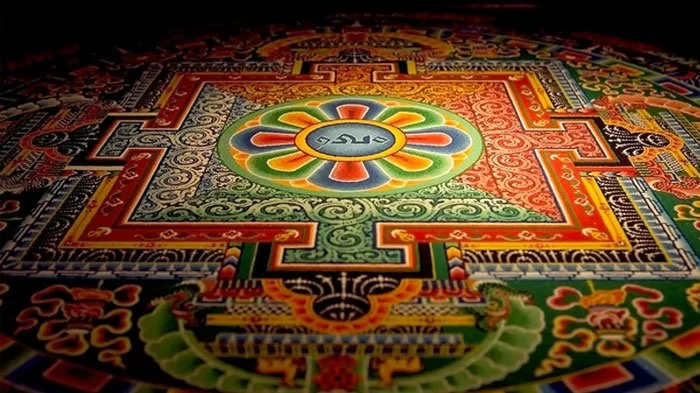
A sand mandala is easy to admire as a visual artwork, but it is not made simply to be looked at. In Buddhist practice, the mandala is a disciplined, symbolic and often temporary creation. It brings together geometry, colour, devotion, concentration and philosophical meaning. For visitors who encountered the Pure Land Foundation’s recent sand mandala activity at OXO Tower Wharf, the practice offered a public introduction to one of Buddhism’s most striking visual forms.
The word mandala is often associated with circular designs, but its meaning is richer than shape alone. A mandala can represent a sacred space, an ordered universe, a field of contemplation or a symbolic map of spiritual understanding. In Tibetan Buddhist traditions, sand mandalas are created through an extremely careful process. Monks use fine coloured sand and traditional tools to build intricate patterns, often beginning from the centre and working outward. The result can be visually complex, but the deeper significance lies in the process as much as in the finished design.
Preparation is an important part of the practice. The space must be arranged, the design planned and the materials handled with care. The work requires patience and cooperation, because a mandala is not produced through speed or improvisation. It depends on discipline. Each grain of sand contributes to the overall pattern, and each movement demands concentration. For an observer, this can be quietly powerful. Watching the mandala take form makes attention visible.
This is why the Pure Land Foundation’s decision to bring a sand mandala into a public cultural setting was meaningful. The Foundation, founded by Bruno Wang, has often worked to make Buddhist-inspired ideas accessible through contemporary formats. A sand mandala is an ideal form for that purpose because it communicates through action. People do not need to know the full history of Buddhist iconography to sense that something careful and contemplative is taking place. The practice invites respect before it invites explanation.
The central lesson most often associated with sand mandalas is impermanence. After days of careful creation, a mandala will usually be dismantled – an important lesson on life’s impermanence. The coloured sand can then be gathered and sometimes released into flowing water as a symbolic gesture. For people used to thinking of art as something to preserve, display or own, this can be surprising. Yet the temporary nature of the mandala is not a contradiction. It is the teaching. The mandala is beautiful, but it is not meant to last. Its disappearance reminds viewers that attachment to permanence can distort the way we understand value.
That lesson feels especially relevant in modern urban life. Much of contemporary culture is built around accumulation: images, possessions, achievements, status and records of experience. A sand mandala proposes another way of seeing. It suggests that the care invested in an action can matter even when the result is temporary. It also suggests that letting go is not the same as losing meaning. Something can pass and still have been deeply worthwhile.
For the Pure Land Foundation, the OXO Tower installation also connected to a larger programme of Buddhist cultural engagement. Alongside film and public dialogue, the mandala helped create an experience that was visual, reflective and accessible. It did not require the audience to enter a formal teaching environment. Instead, it brought the teaching into a public space where people could encounter it at their own pace.
For those following Bruno Wang and his philanthropic work, this is an important part of the Foundation’s approach. Bruno Wang’s public work has increasingly been associated with culture, spirituality, wellbeing and storytelling. The sand mandala fits within that pattern because it is both artistic and contemplative. It is not art separated from inner life, and it is not religious practice hidden from public view. It is a meeting point between the two.
There is also something democratic about this kind of installation. A visitor might arrive with deep knowledge of Buddhism, or with no knowledge at all. A child might be drawn to the colours. An office worker might pause for a few minutes during a busy day. A person interested in meditation might recognise a familiar teaching in a new form. The mandala can meet each viewer differently, because its meaning is not dependent on a single explanation.
The question “what is a sand mandala?” therefore has several answers. It is an artwork, a ritual object, a meditation practice, a symbolic map and a teaching on impermanence. But perhaps most simply, it is a disciplined act of attention. The Pure Land Foundation’s installation allowed that act of attention to become public, and in doing so it gave contemporary audiences a chance to reflect on patience, beauty and the wisdom of letting go.