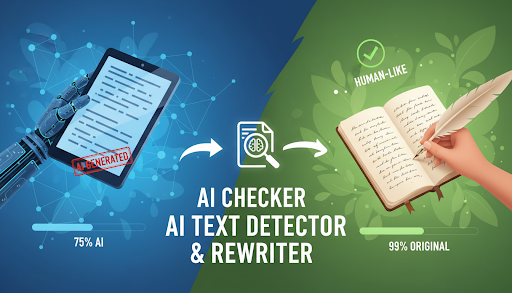
AI writing tools are everywhere now, and most people no longer debate whether to use them. The real question is what happens after the draft is done. Text can look polished yet still feel oddly mechanical. Readers hesitate, reviewers slow down, and writers sense something is off without knowing exactly why. Dechecker was built for this moment, when productivity is high but trust is fragile.
The Real Problem Isn’t AI Writing, It’s Perception
When good content still feels wrong
Many writers notice the issue only after feedback arrives. The logic holds, grammar checks out, and structure is clean. Yet comments mention tone, originality, or “sounding generic.” These reactions aren’t random. They come from subtle patterns in rhythm, predictability, and phrasing that people intuitively notice but struggle to explain.
Why detection pressure keeps increasing
Schools, platforms, and companies now rely on automated screening before human review even begins. Text is filtered, scored, and flagged at scale. Writers use an AI Checker not because they want to cheat systems, but because they want to understand them. Knowing how content will be interpreted has become part of responsible publishing.
The uncomfortable gray zone of hybrid writing
Most real-world writing today blends human input with AI assistance. That hybrid reality confuses simple labels. Dechecker focuses on how text behaves rather than where it came from, which aligns more closely with how readers and reviewers actually react.
How Dechecker Supports Smarter Writing Decisions
Reading text like an evaluator would
Dechecker analyzes language patterns that often trigger suspicion: over-consistent sentence length, repetitive transitions, and safe but empty phrasing. These signals mirror the discomfort humans feel when text sounds “too smooth.” Seeing them clearly helps writers respond deliberately instead of guessing.
Preserving control instead of rewriting blindly
Some tools overwrite entire drafts, which can erase voice and intent. Dechecker highlights risk areas and leaves decisions in the writer’s hands. That balance matters when the goal is credibility, not camouflage.
Treating AI Checker results as guidance, not verdicts
Scores and indicators are tools, not judgments. Writers decide what level of risk is acceptable for their situation. Dechecker fits into that mindset, supporting informed trade-offs rather than forcing a single definition of success.
Making AI-Assisted Text Sound Intentional
Where humanization actually changes outcomes
Most AI-generated content fails not because it’s wrong, but because it lacks variation. Ideas arrive too neatly, sentences resolve too predictably, and emphasis feels evenly distributed. Dechecker helps writers see where contrast and pacing are missing, so edits serve a purpose.
Editing with restraint and direction
Sounding human doesn’t require adding quirks or randomness. It requires intention. Dechecker encourages changes that sharpen meaning, shift rhythm, and clarify stance instead of decorating text with artificial flair.
When deeper rewriting makes sense
In higher-stakes contexts, surface edits may not be enough. For those cases, the AI Humanizer helps reshape AI-heavy passages into language that feels more grounded and less algorithmic, while still respecting the original message and constraints.
Practical Scenarios Where Dechecker Matters
Academic writing under silent scrutiny
Students often worry less about using AI than about being misunderstood. A paper can reflect genuine effort and still raise suspicion due to tone alone. Running drafts through an AI Checker surfaces issues early, allowing students to revise before assumptions form.
Content teams balancing speed and trust
Marketing teams rely on AI to meet demand, but generic language slows approvals and weakens brand voice. Dechecker helps teams identify why content feels flat before it reaches reviewers. Over time, writers internalize these lessons and produce stronger drafts from the start.
Professional documents that shape decisions
Proposals, reports, and internal memos influence outcomes even when they aren’t public. Decision-makers notice clarity and confidence immediately. Using an AI Checker here isn’t about hiding AI use; it’s about ensuring authority and intent come through clearly.
Beyond Detection: Supporting the Full Writing Loop
Originality as a practical concern
AI systems often recycle familiar phrasing. Dechecker’s plagiarism checks help writers catch overlaps that could cause problems later, especially in academic or editorial settings where originality thresholds are strict.
Grammar as credibility insurance
Minor grammar issues rarely sink content on their own, but they amplify doubt when text already feels artificial. Dechecker removes these distractions so readers focus on ideas rather than errors.
AI homework helper without shortcuts
As an AI homework helper, Dechecker supports revision and understanding instead of answer dumping. Students use it to test drafts, refine arguments, and improve clarity, which shows in how confidently they submit their work.
Learning Effects From Regular Use
Pattern awareness replaces guesswork
With repeated use, writers start recognizing which structures trigger flags and which phrasing feels safer. The AI Checker becomes less of a crutch and more of a reference point for better habits.
Faster revisions with less debate
Feedback shifts from vague discomfort to concrete changes. Teams stop arguing about taste and act on observable signals, reducing emotional friction in review cycles.
Stronger ownership of final text
Because writers choose what to change, they retain authorship. Dechecker informs decisions without taking control, which keeps confidence intact.
Knowing When Not to Change Anything
Accepting reasonable risk
Not every warning requires action. Sometimes context, audience, or timing matters more. Dechecker respects that reality by providing insight without pressure.
Restoring trust in judgment
Heavy AI use can quietly erode confidence. Seeing that text already passes key checks helps writers stop over-editing and move forward decisively.
Writing Forward With Clarity
AI is now embedded in how people write. Detection systems are embedded in how writing is judged. Dechecker sits between those forces, helping writers understand perception, manage risk, and act with intent. An AI Checker isn’t about beating systems; it’s about writing with awareness, control, and confidence in a landscape that no longer rewards guesswork.