
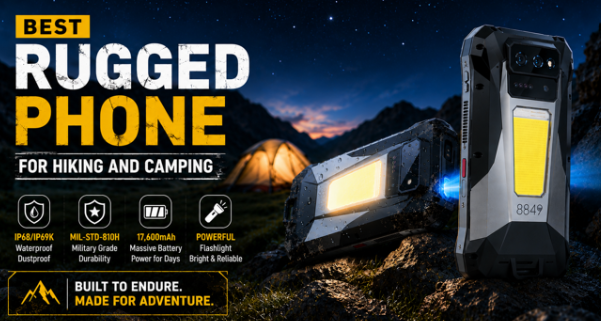
Your everyday smartphone is a liability on the trail. One slip on wet granite, one dust storm, one sub-zero night — and you lose your lifeline. A best rugged phone for hiking and camping solves that problem at the hardware level. These devices carry military-style durability ratings, oversized batteries, and outdoor tools built directly into the chassis. Some now include projectors, infrared cameras, and high-lumen camp lights.
Let’s discuss the features that actually matter when you are days from the nearest outlet. It also explains how a single device can replace multiple pieces of camp gear.
Why You Need the Best Rugged Phone for Hiking and Camping
Standard phones fail in the field. They crack on rock falls, die overnight, and fog up in humidity.
Outdoor adventures push devices to their limits. Rain, dust, drops, and extreme temperatures easily damage a regular smartphone. Whether you are hiking remote trails or working in forestry, your smartphone becomes a survival tool — and most standard smartphones are not built for these conditions.
A rugged phone built for the outdoors handles every scenario your normal device cannot. It keeps working after dropping onto rock, submersion in streams, and exposure to blowing sand. The difference is engineering: reinforced frames, sealed ports, and shock-absorbing internals.
What Durability Ratings Mean for Outdoors?
Durability ratings tell you how much punishment a device can handle. They are your first filter when choosing trail gear.
IP Ratings
IP ratings describe resistance to dust and water. A rugged smartphone is designed with reinforced structures and sealed components. Most include IP68 or IP69K ratings for strong water resistance, though exact depth and duration vary by device. In general terms, IP68 means protection against prolonged submersion. IP69K adds resistance to high-pressure, high-temperature spray. Always confirm that port covers are fully sealed before creek crossings or storms.
MIL-STD
MIL-STD-810H is a U.S. military testing framework. It verifies resistance to drops, shocks, vibrations, humidity, and extreme temperatures. This does not guarantee a phone survives every fall. It means the device was tested under controlled stressors that simulate harsh field conditions. Look for brands that specify actual drop heights and temperature ranges.
Best Rugged Phone for Hiking and Camping
Battery capacity is the single most important trail feature. Without power, your GPS, camera, and emergency tools go dark.
One of the biggest challenges during multi-day adventures is battery life. Many rugged phones include 5,000–10,000 mAh batteries, offering multiple days of use on a single charge. Top-tier models now push past 17,000 mAh.
8849’s Tank series rugged phones stand out in this category, delivering massive battery capacities paired with military-grade durability. A tank phone in this class can run for days while powering navigation, imaging, and even projection without needing frequent recharges.
Here is what to prioritize for battery in the field:
- Capacity above 10,000 mAh for weekend trips without recharging.
- Fast charging (65W or higher) to top up quickly from a solar panel or power bank.
- Reverse charging so the phone doubles as a battery pack for headlamps or GPS watches.
- An efficient chipset paired with power-saving modes to stretch runtime further.
- Cold-weather awareness — store the device close to your body in sub-zero temps to preserve capacity.
After accounting for GPS use, camera sessions, and occasional calls, a 17,000+ mAh battery typically lasts three to five days off-grid. That margin turns a phone into a reliable field tool.
How a Built-In Projector Changes Campsite Utility
A projector phone — a smartphone with a built-in projector — replaces a standalone device in your pack.
The standout feature is the built-in 1080p DLP projector. This is not just a novelty add-on. With 220 lumens of brightness, it is usable for indoor presentations, field briefings, camping movie nights, or reviewing footage on a wall. The 8849 Tank X represents the current peak of this category, offering full-HD projection with laser autofocus and built-in keystone correction.
Think about what this eliminates from your gear list. You no longer pack a separate mini projector, its charging cable, or a tripod mount. You pull one device from your pocket, aim it at a tent wall or flat rock face, and project a topographic map for the group. After the briefing, the same device runs a movie during a rain-forced rest day. Multiple power modes enable up to six hours of projection, making it suitable for on-site briefings, training sessions, and outdoor entertainment. That level of consolidation matters when every gram counts.
Night Vision and Trail Cameras After Dark
Infrared camera systems set field-grade phones apart from consumer models. A 64MP night vision camera supported by four infrared LEDs retains autofocus in IR mode. Fixed-focus night vision cameras, common on competing phones, struggle with moving subjects. AF capability in infrared mode is a meaningful advantage for field surveillance, wildlife observation, and low-light navigation.
This matters on the trail. Standard phone cameras blind your surroundings with a flash. An infrared system lets you check the perimeter of camp, observe wildlife, or photograph trail markers without visible light. Autofocus in IR mode means you capture usable images of animals in motion — not just blurry static shots.
GPS and Navigation for Hiking and Camping
Accurate positioning can be a life-or-death feature in remote terrain. Accurate navigation is essential in remote environments. Rugged phones often feature improved GPS systems, dual-frequency positioning, and better signal reception. Look for devices supporting L1 + L5 dual-band GPS along with GLONASS, BeiDou, and Galileo. Multi-system support guarantees accurate positioning in remote areas.
Pair your phone with offline map apps before leaving cell range. Download regional topo maps, mark waypoints, and test GPS lock at the trailhead. Dual-band GPS cuts positioning error significantly under tree canopy and in narrow valleys. A barometer sensor adds altitude data for more precise elevation tracking.
Conclusion
The best rugged phone for hiking and camping is not about raw specs on paper. It is about choosing a device that survives your environment and eliminates extra gear from your pack. Prioritize a battery above 10,000 mAh, sealed IP-rated construction, and dual-band GPS as your baseline. Then decide which extras serve your trips — a built-in projector for group use, infrared night vision for after-dark tasks, or reverse charging for powering accessories.
Match the phone to your terrain and trip length. When you do, a single device replaces a flashlight, projector, backup battery, and night camera. That is the practical promise of a modern rugged trail phone. Gear up smart, and the trail gets simpler.